
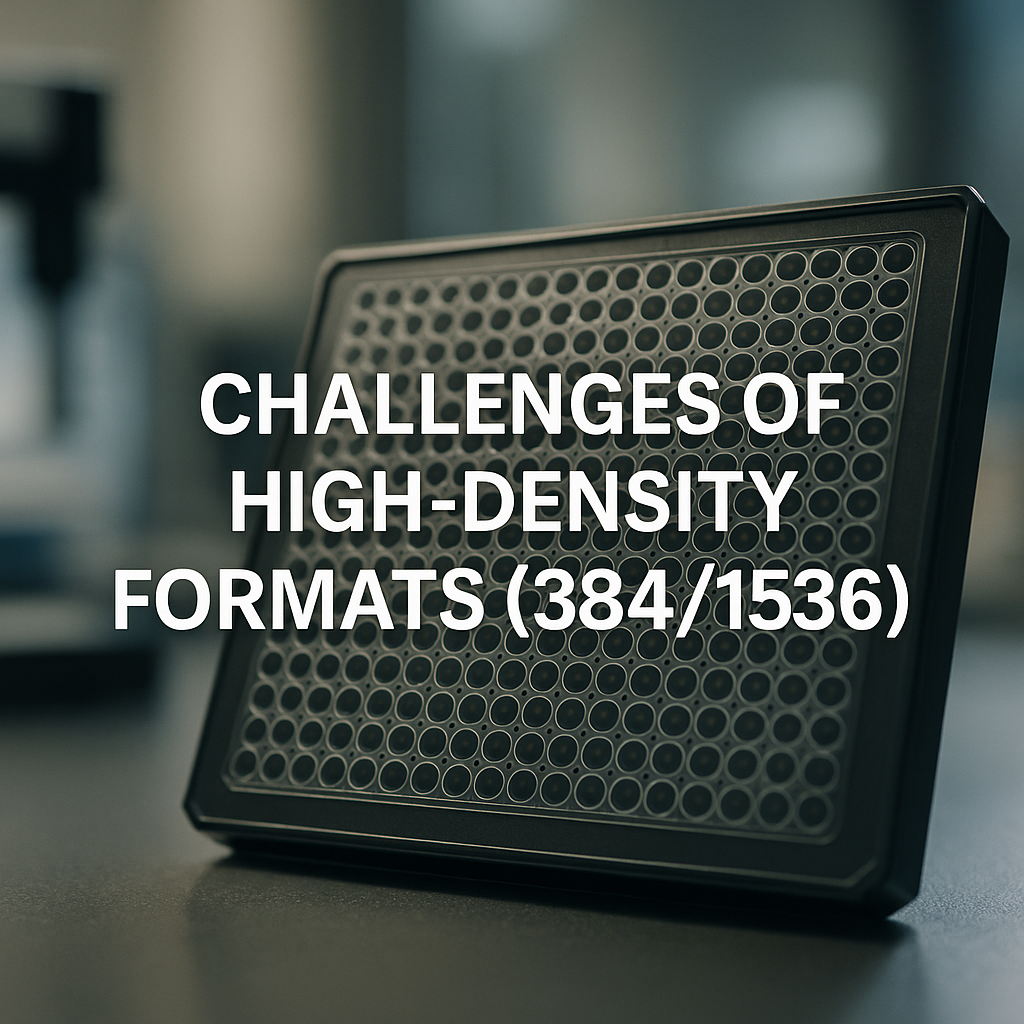
Challenges of High-Density Formats (384/1536)
The introduction of high-density formats, such as 384 and 1536 well plates, has revolutionized the landscape of life science research and biotechnological applications. These advancements offer significant benefits in terms of throughput and efficiency. However, they also present unique challenges, especially in the context of manufacturing, quality control, and consistent performance in cGMP environments. This article delves into the multifaceted challenges associated with these high-density formats and provides insights into overcoming them for optimal laboratory operations.
Common Challenges and Limitations
Manufacturing Complexities
High-density formats like 384 and 1536 well plates require precision manufacturing techniques to ensure the accuracy and consistency necessary for reliable experimental results. The increase in well quantity per plate amplifies the manufacturing complexities, including tooling precision, material selection, and surface treatment requirements. These factors can significantly impact throughput, scalability, and quality.
- Dimensional accuracy: Essential for ensuring uniform well size and volume.
- Material compatibility: Polystyrene (PS) and polypropylene (PP) are commonly selected, but material consistency is crucial for maintaining performance.
- Surface treatment: Requirements vary based on assay types and can include tissue culture (TC) treated or other specialized coatings.
Technological Advances and Automation Trends
Integration of Automation in High-Density Formats
As high-density formats become more prevalent, the need for integrating advanced automation solutions escalates. Automation in processing these plates not only enhances throughput but also improves data accuracy through reduced human error. Navigating these advancements requires a thorough understanding of the technologies involved, including the precision of automated pipettes and the use of real-time monitoring systems.
- Robotic integration: Enhances efficiency and reduces contamination risk.
- Process monitoring: Continual data collection and error detection improve outcome reliability.
- Cross-platform compatibility: Enables seamless workflow integration across various laboratory instruments.
Practical Workflows and Live-Cell Imaging
Optimizing with Live-Cell Imaging Systems
In the realm of advanced laboratory procedures, live-cell imaging systems have proven invaluable for their role in continuous monitoring and real-time data acquisition. Utilizable within high-density formats, these systems, such as the zenCELL owl, facilitate profound improvements in study reproducibility and transparency.
- Real-time tracking: Allows continuous observation and analysis of cellular events.
- Non-invasive monitoring: Enables the preservation of cell integrity over time.
- Data redundancy reduction: Enhanced reproducibility through standardized workflows.
Enhancements in Reproducibility and Data Quality
Incubator-Compatible Imaging Systems
The incorporation of incubator-compatible imaging systems within high-density workflows is pivotal for enhancing data fidelity. These systems track cell cultures within their native environment, ensuring the collection of high-quality data over iterative assay progressions.
- Maintained environmental conditions: Crucial for cellular viability and assay consistency.
- Automated data logging: Facilitates comprehensive data sets for thorough analysis.
- Increased throughput: More plates processed with greater accuracy per unit time.
Applications of High-Density Formats
Broadening the Scope of Research Applications
High-density formats are at the forefront of contemporary research applications, offering widespread utility in various complex workflows, such as migration assays, organoid cultures, proliferation studies, and high-throughput screening (HTS).
- Migration assays: Improved precision and throughput enhance study reliability.
- Organoids and 3D cultures: Provide robust platforms for more physiologically relevant data.
- Proliferation studies: High-scale parallel analysis of growth conditions and effects.
- HTS: High-density formats significantly increase the efficiency of compound screenings in drug discovery.
Continue reading to explore more advanced insights and strategies.
„`html
Harnessing Flexibility in Assay Design
Leveraging Modularity of High-Density Formats
In the rapidly evolving field of biotechnology, flexibility in experimental design is critical. High-density formats like 384 and 1536 well plates offer unparalleled modularity, allowing researchers to tailor their setups based on specific assay requirements. This feature is particularly beneficial for laboratories that frequently pivot their focus or investigate diverse biological phenomena.
- Customizable layouts: Facilitate integration into various experimental protocols.
- Adaptive scaling: Enables smooth transitions between different experimental scales without significant retooling.
- Increased experimental precision: Smaller well volumes reduce reagent consumption and enhance reaction accuracy.
Data Management and Analysis Best Practices
Streamlining Data Handling for High-Density Workflows
As the volume of data from high-density plates can be immense, precise data management and analysis strategies become pivotal. Implementing robust software solutions that cater to data collation, visualization, and analysis offers a competitive edge in deriving meaningful insights from complex data sets. Advanced bioinformatics tools and machine learning algorithms further enhance the depth of analyses, unlocking predictive insights that traditional methods might overlook.
- Utilize centralized data systems: Enable seamless data integration and accessibility.
- Employ visualization tools: Facilitate clearer insights and pattern recognition.
- Invest in AI-centric platforms: Discover hidden data trends and predictive outcomes.
Safeguarding Consistency and Quality
Implementing Rigorous Quality Control Protocols
Maintaining consistency across high-density formats is essential for reliable outcomes. By adopting stringent quality control protocols, labs can mitigate variability. This involves validating each stage of the workflow such as plate manufacturing, reagent quality, and operational procedures to ensure assay fidelity. Benchmarking with internal standards provides a basis for continuous improvement and error correction.
- Incorporate regular calibration: Ensures equipment and plates perform within specifications.
- Standardize operation protocols: Minimizes inter-experiment variability.
- Track performance metrics: Key for consistent progress assessment and planning.
Pioneering Collaborative Research Environments
Fostering Shared Usage of High-Density Resources
Fostering collaboration in research environments can maximize the utility and cost-effectiveness of high-density formats. Shared laboratory spaces, equipment, and data repositories encourage interdisciplinary projects, enhancing innovation, and resource optimization. Such cooperative frameworks are increasingly vital in addressing multifaceted global challenges, where pooled expertise and shared infrastructures are pivotal for breakthrough advancements.
- Create shared resources: Reduces overhead costs and increases accessibility.
- Promote data openness: Facilitate collaborative analyses and shared learning.
- Develop joint ventures: Integrate cross-disciplinary skills and perspectives.
Innovations in High-Throughput Screening (HTS)
Advancing Drug Discovery with 1536 Well Plates
High-density formats are indispensable in the acceleration of high-throughput screening (HTS), particularly in drug discovery and pharmacological research. The extensive array capacity of 1536 well plates significantly increases throughput, enabling the evaluation of vast compound libraries in parallel. Innovations such as miniaturized reaction environments and next-gen assay technologies have been instrumental in refining the accuracy and value of HTS.
- Adopt cutting-edge assay tech: Enhances the robustness of screenings and outcomes.
- Utilize cheminformatics: Increases the efficiency of lead compound identification.
- Leverage microfluidics: Supports efficient compound dispensations and reduces waste.
Implementing Environmental Sustainability Principles
Reducing Waste and Optimizing Resources in High-Density Workflows
Sustainability in laboratory practices is becoming increasingly important. By optimizing high-density formats, labs can minimize environmental impacts, primarily through reduced material consumption and waste generation. Utilizing reusable resources, eco-friendly materials, and strategic energy management contributes to a reduced carbon footprint while maintaining scientific integrity.
- Embrace reusable components: Lowers waste generation and procurement costs.
- Integrate sustainable practices: Align research objectives with environmental ethics.
- Optimize energy use: Utilizes energy-efficient equipment to lower operational costs.
Navigating Intellectual Property in Shared Environments
Balancing Innovation and Legal Protections
The collaborative nature of high-density formats often intersects with intellectual property (IP) concerns. Establishing clear legal frameworks that protect inventions while encouraging scientific collaboration is key. Researchers and institutions must understand the nuances of IP as they navigate shared environments, ensuring that innovations remain protected while contributing to the collective scientific good.
- Clarify IP agreements upfront: Prevent potential disputes over shared contributions.
- Promote open innovation models: Encourage collaboration while respecting IP rights.
- Educate on IP strategies: Empower researchers to protect and capitalize on innovations.
Next, we’ll wrap up with key takeaways, metrics, and a powerful conclusion.
„`
„`html
Balancing Cost Efficiency with High-Density Technologies
Optimizing Budget Without Compromising Quality
Incorporating high-density formats such as 384 and 1536 well plates can be resource-intensive, requiring strategic allocation of laboratory budgets. Despite initial investments in specialized equipment and resources, the long-term cost savings are significant. With judicious budgeting and resource management, labs can achieve both financial efficiency and exceptional experimental quality.
- Implement cost-effective procurement strategies: Better allocation of budget resources without sacrificing quality.
- Evaluate return on investment (ROI): Regularly assess the performance of high-density systems to ensure value generation.
- Encourage bulk purchasing: Leverage economies of scale to reduce per-unit costs.
Enhancing Training for High-Density Assay Platforms
Building Expertise to Maximize System Capabilities
As high-density technologies become commonplace, building a workforce skilled in their application is crucial for maintaining competitive and innovative laboratories. Developing comprehensive training programs ensures that personnel can properly leverage these tools. Such initiatives also promote confidence and proficiency in handling complex assay technologies.
- Develop comprehensive training modules: Tailored to various proficiency levels within the organization.
- Promote hands-on workshops: Encourage skill enhancement and confidence in using high-density equipment.
- Implement mentorship programs: Facilitates knowledge transfer and cultivates future leaders in the field.
Conclusion
The adoption of high-density formats like the 384 and 1536 well plates has ushered in a new era of efficiency and precision in scientific research. By harnessing the flexibility of assay design, labs can pivot and adapt to the dynamic demands of biotechnology research. Emphasizing robust data management and stringent quality control ensures that the results are not only reliable but also replicable.
In addition to methodological enhancements, fostering collaborative research environments plays a pivotal role in maximizing resource utility and driving innovation. Integrating environmental sustainability principles further enhances the societal and ecological impact of scientific endeavors. Meanwhile, navigating the complexities of intellectual property in shared settings protects both individual and collective scientific contributions.
The strategic implementation of high-density formats cannot be separated from considerations of cost efficiency, training, and technological adoption. Laboratories must remain agile, budget-conscious, and ever-willing to upskill their workforce to exploit these advanced platforms fully. The significant savings and increased throughput enabled by these technologies justify investments that initially may seem daunting.
Ultimately, the integration of high-density formats in an evolving biotechnological landscape not only propels scientific discovery but also promotes a culture of innovation, collaboration, and sustainability. As the complexities of global challenges intensify, the scientific community is called upon to transcend traditional limits and embrace tools and strategies that drive meaningful progress and groundbreaking discoveries.
Let this journey of exploration and discovery inspire you to rethink your laboratory’s capabilities, strive for excellence in scientific research, and make informed decisions that align with both your scientific goals and ethical responsibilities. Embrace the potential of these high-density technologies and challenge the boundaries of knowledge to unlock a brighter, more innovative future in biotechnology.
„`
 German
  English
Schreibe einen Kommentar