
„`html
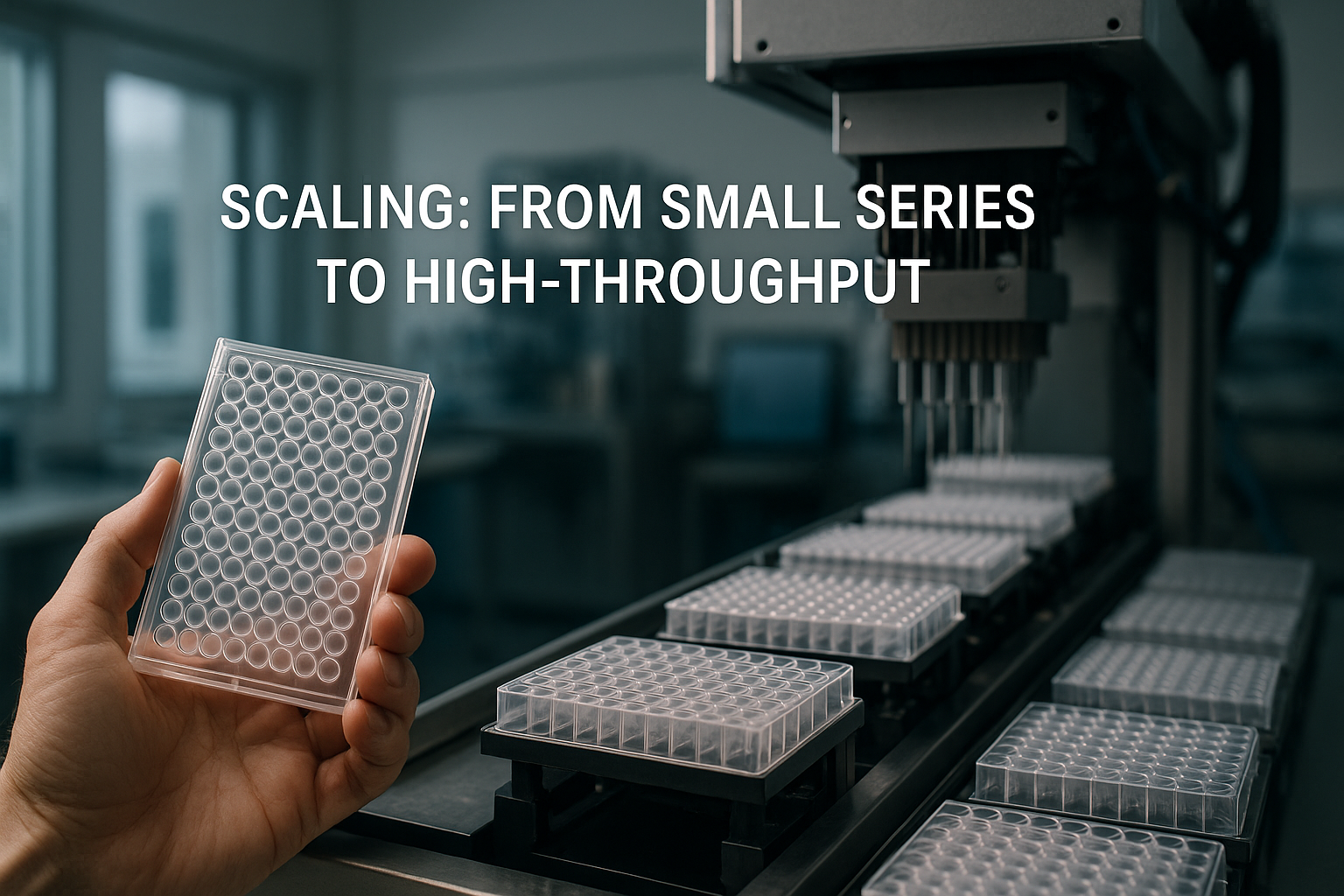
Scaling: From Small Series to High-Throughput
In modern life science research, the transition from small series experiments to high-throughput production is critical for advancing applications like drug development, diagnostics, and novel therapeutic approaches. As laboratories and biotech companies push the boundaries of innovation, the scalability of laboratory plastics becomes paramount. This article delves into the multifaceted journey from concept to large-scale manufacturing, highlighting essential practices, challenges, and technological advancements that facilitate this evolution.
Understanding the Challenges of Traditional Manufacturing Approaches
The journey from prototyping to mass production of laboratory plastics, such as multiwell plates and cell culture vessels, is fraught with challenges. Traditional methods often stumble over limitations in design flexibility, material consistency, and production capacity. These issues not only impede scalability but also affect the reliability and reproducibility of experimental outcomes.
Moreover, achieving precision in design-for-manufacturing (DFM) is crucial. The selection of appropriate materials, such as polystyrene (PS), polypropylene (PP), and cyclo-olefin copolymers (COC), further adds complexity. Surface treatments tailored for specific applications—such as tissue culture-treated (TC-treated) or special coatings—are essential to ensure the optical and biological compatibility of the products. Prototyping strategies must therefore address these challenges head-on to allow seamless scaling from small-scale development to high-throughput production.
Technological Advances Transforming Lab Plastic Manufacturing
Recent advancements in manufacturing technologies, including injection molding, have revolutionized the scaling process from small to high-throughput production. Injection molding allows for precision and consistency through process validation and critical control parameters. In regulated environments compliant with cGMP/GMP standards, maintaining this consistency across batches is vital.
Process control mechanisms enhance traceability, documentation, and quality management systems, which are indispensable for risk management and ensuring product integrity. Pilot tooling and full industrial-scale tooling pivotally contribute to dimensional accuracy, scalability, and process robustness.
- Injection molding fosters reproducibility and high-stakes process control.
- Quality management systems and documentation fortify compliance in cGMP/GMP environments.
- Advanced prototyping strategies augment flexibility and scalability.
The Role of cGMP and GMP in Scaling
Differentiating between development environments, cGMP-compliant production, and GMP manufacturing is crucial when discussing scalability within laboratory plastic manufacturing. Each phase is characterized by stringent quality control measures, from material selection to comprehensive batch documentation.
Structured quality management systems including change control and validation principles underpin the reliability of scaling processes. They are delineated by defined qualification procedures ensuring that every scaled-up product meets stringent industry standards, crucial for pharma- and diagnostics-grade customers seeking reliable long-term supply chains.
Additionally, the implementation of risk management protocols addresses challenges in the lifecycle management of lab plastic products, especially as production scales from niche to large-scale industrial outputs.
- Distinction between development, cGMP, and GMP stages enhances compliance.
- Risk management protocols are crucial for lifecycle management.
From Small Batch to Industrial Production
The transition from small-batch production to medium-scale OEM supply and full-scale industrial production demands both agility and precision. Flexibility in production allows for the tailoring of processes to accommodate diverse client needs and the variability of research demands.
By focusing on flexibility and the robustness of long-term supply strategies, manufacturers ensure reliability, critical for sustaining research and end-use applications. Effective lifecycle management of lab plastic products also extends beyond scalability, influencing continuous improvement and adaptation to new market demands.
- Flexibility is key in tailoring production processes.
- Long-term supply reliability supports sustained research development.
- Lifecycle management influences scalability and market adaptation.
Ensuring Quality and Consistency in High-Throughput Production
The journey from concept to high-throughput manufacturing is not solely about increasing the number of units produced; it is about ensuring that quality and consistency remain sacrosanct. Critical process parameters, traceability, and documentation become more complex as production scales up. Nevertheless, maintaining stringent quality assurance practices throughout the process ensures that even at the most extensive scale, each product meets the necessary standards for research and application.
- Quality and consistency are paramount at all scales of production.
- Comprehensive documentation supports process integrity.
Continue reading to explore more advanced insights and strategies.
„`
„`html
Optimizing Supply Chain for Scalable Growth
Streamlined Logistics for Seamless Production Scaling
As laboratories transition from small-batch to high-throughput production, the efficiency of the supply chain becomes a pivotal component of success. A streamlined supply chain ensures that all resources, from raw materials to finished products, are available at the right time in the right quantities. Advanced supply chain strategies, like Just-In-Time (JIT) inventory management, help reduce waste and improve the responsiveness to demand variability.
Companies like Thermo Fisher Scientific implement integrated logistics solutions which link procurement, production, and distribution seamlessly. By employing technologies such as blockchain and IoT, transparency across supply chain operations is enhanced, reducing the risk of disruptions.
- Adopt JIT strategies to minimize holding costs and enable flexible responses to market changes.
Design and Innovation for Scalable Production
Balancing Product Innovation with Scalability
Innovation in product design is critical, but it poses challenges when aiming for scalability. Breakthrough products must be developed with future mass production in mind. High-grade CAD software and simulation tools like ANSYS allow engineers to model and test product designs rigorously before investing in costly manufacturing processes.
Companies like GE Healthcare use a „Design for Excellence“ (DfX) approach, integrating customer feedback and iterative prototyping to refine products. Implementing changes early in the design stage reduces bottlenecks later and aligns innovative designs with scalable manufacturing processes.
- Utilize CAD simulations to evaluate design feasibility at scale.
Leveraging Data Analytics for Enhanced Production Efficiency
Data-Driven Decision Making in High-Throughput Environments
Big data analytics has become crucial in modern high-throughput production environments, transforming how manufacturers approach scalability. Tools like SAP HANA and Tableau help organizations analyze production data in real-time, offering insights for enhancing efficiency and reducing waste.
Case studies from pharmaceutical companies illustrate that using advanced analytics can increase process efficiency by over 20% and significantly reduce time-to-market. A data-driven approach not only improves production line workflows but also enhances predictive maintenance capabilities, ensuring equipment uptime.
- Implement predictive analytics to anticipate maintenance needs and optimize production schedules.
Collaborative Efforts in Scaling Production
Building Partnerships for Shared Success
Scaling production is inherently collaborative, requiring the coordination of multiple stakeholders. Partnering with OEMs, technology providers, and distributors can enhance scalability. This involves sharing best practices, innovations, and market insights, leading to more robust and flexible production processes.
Initiatives like the NSPC open innovation project exemplify the benefits of collaborative scaling. By leveraging expertise across different domains, companies can identify synergies and streamline the scaling process for shared gains.
- Engage with industry partners to harness shared expertise and resources.
Environmental Considerations in Large-Scale Manufacturing
Incorporating Sustainability into High-Throughput Processes
Sustainability in large-scale manufacturing is more than a trend—it’s a necessity. Implementing eco-friendly practices not only alleviates environmental concerns but also enhances brand reputation and meets regulatory demands. Techniques such as green manufacturing and the use of recyclable materials are becoming standard.
Companies like Corning Incorporated have set benchmarks by incorporating LED tech, energy-efficient equipment, and biodegradable inputs, significantly reducing carbon footprints in their operations.
- Adopt sustainable practices to reduce environmental impact and operational costs.
Embracing Automation in the Scaling Journey
Automation Technologies as Catalysts for Consistency and Speed
Automation plays a crucial role in scaling production from small to high-throughput. Robotic systems and AI-driven automation can handle complex tasks efficiently and consistently. The use of smart robotics in processes like packaging and quality control can tremendously improve output speed and accuracy.
For example, in Johnson & Johnson’s facilities, integrated AI systems enhance efficiency, achieving unprecedented levels of throughput without compromising on accuracy.
- Invest in automation technologies to augment quality and production speed.
Training and Upskilling the Workforce for High-Throughput Manufacturing
Preparing Human Resources for Advanced Manufacturing Technologies
The shift towards high-throughput production necessitates a workforce skilled in advanced manufacturing technologies. Continuous training and development programs ensure that workforce capabilities align with the technological advancements in manufacturing. Online training platforms and workshop sessions led by industry experts are becoming standard practice.
Leading contractors such as Siemens emphasize workforce upskilling through cross-functional training programs, equipping staff to handle new equipment and software efficiently.
- Implement regular upskilling programs to ensure a technically proficient workforce.
Next, we’ll wrap up with key takeaways, metrics, and a powerful conclusion.
„`
„`html
Implementing Effective Change Management
Navigating Transition Phases in Scaling Operations
Transitioning to high-throughput manufacturing requires more than just adopting new technologies—it demands effective change management strategies. Organizations must ensure that new processes are communicated clearly across all levels of the workforce, supported by a robust change management plan. This includes comprehensive training sessions, clear documentation, and a supportive leadership team that champions the shift.
Companies such as Boeing have excelled in implementing change management by developing detailed roadmaps that align with their strategic goals while maintaining transparency throughout the organization. This not only minimizes resistance but also fosters a culture ready to embrace continual innovation and improvement.
- Develop a change management plan to facilitate smooth transitions to new manufacturing practices.
Quality Assurance in High-Throughput Production
Maintaining Standards with Increased Output
As production scales, maintaining quality assurance becomes critical. Ensuring that each product meets rigorous standards requires refined quality management systems that can adapt to increased output. Techniques such as Six Sigma have proven effective in reducing defects and ensuring uniformity in large-scale production environments.
At companies like Toyota, quality is integrated into every stage of the production process, often using automated systems for continuous monitoring and control. This commitment to quality helps maintain customer trust and mitigates the risk of large-scale recalls, which can be detrimental to both reputation and finances.
- Incorporate continuous quality monitoring systems to maintain high standards as production scales.
Key Metrics to Monitor During Scaling
Ensuring Efficiency and Success in Production Expansion
Monitoring key performance metrics is essential in navigating the complexities of scaling production. Metrics such as Overall Equipment Effectiveness (OEE), throughput rate, and defect density provide critical insights into the efficiency and effectiveness of the manufacturing process.
Procter & Gamble exemplifies the importance of these metrics, employing real-time analytics to track production efficiency and swiftly address any deviations. Tracking these indicators allows organizations to make data-driven decisions, optimizing resource allocation and ensuring that the scaling of operations leads to sustainable growth.
- Implement real-time monitoring of key metrics to gain insights into manufacturing efficiency.
Conclusion
In this comprehensive exploration of scaling from small-batch to high-throughput production, it’s clear that integrating advanced supply chain strategies, innovation in design, data analytics, and collaborative efforts is vital. Also, addressing environmental concerns, embracing automation, and continuous workforce development are critical components that feed into the larger narrative of successful scaling. Each aspect, from logistics to workforce competency, plays a pivotal role in ensuring that the transition occurs smoothly, responsively, and sustainably.
Reinforcing this article’s relevance, we see that in today’s fiercely competitive manufacturing landscape, the ability to scale efficiently determines market leadership and profitability. Organizations that adeptly manage the intricate processes of scaling production will position themselves as industry frontrunners. They will not only meet customer demands but exceed them, staying ahead through innovative practices and resilient supply chains.
The journey towards scalable growth is filled with challenges, but with the right strategies and a dedicated team, the rewards are substantial. Organizations are called to action—to employ these insights and refine their production processes for unparalleled growth and success. It is a resolute dedication to innovation, collaborative synergy, and sustainable practices that ultimately charts the path toward transformation. As manufacturers embark on this scaling journey, remember that the commitment to excellence, supported by cutting-edge technology and strategic partnerships, leads to shared success and a promising future.
„`
 German
  English
Schreibe einen Kommentar