
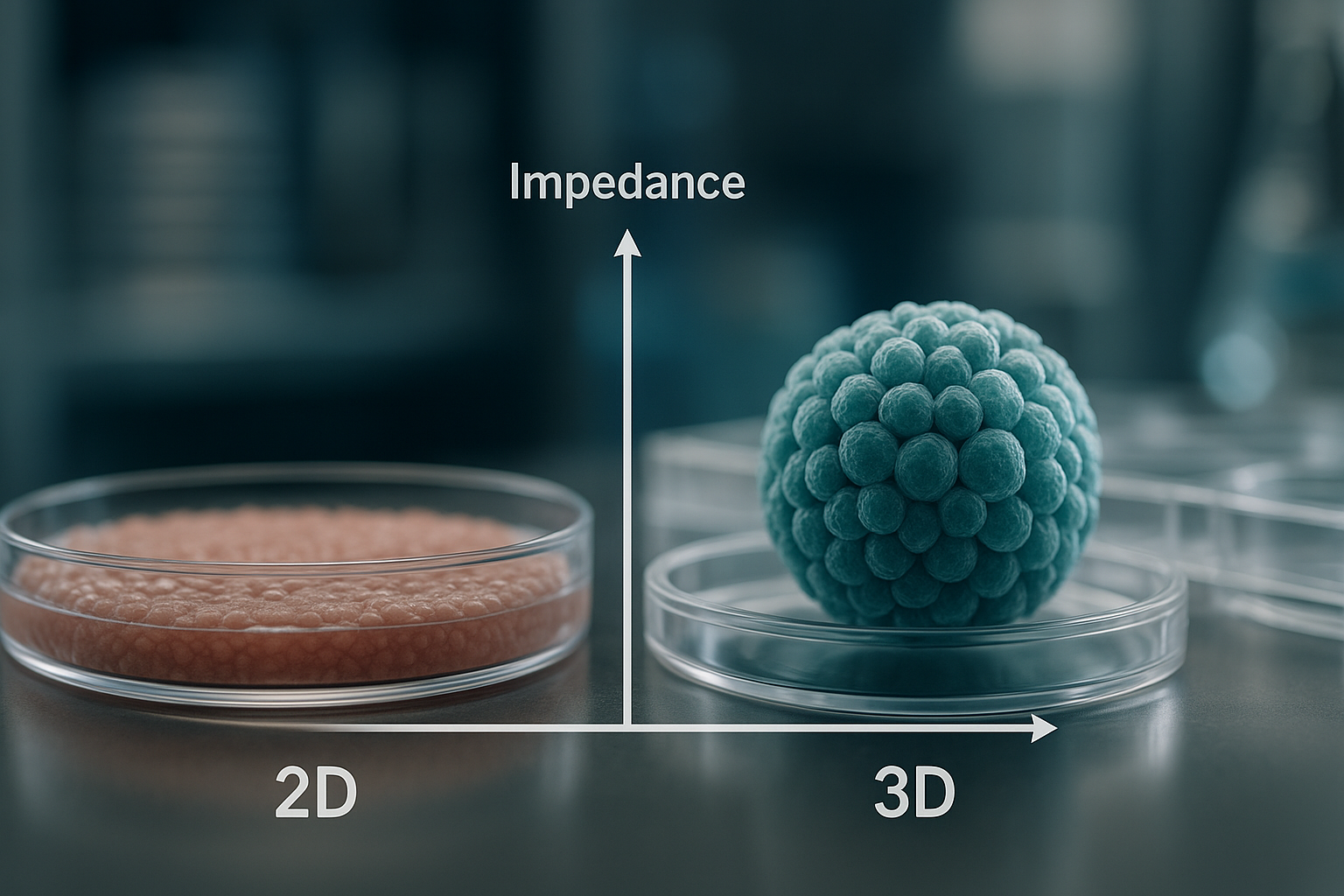
Impedance in 2D vs. 3D Cell Culture
In recent years, the intricacies of cell culture have evolved significantly, offering new dimensions to research involving cellular dynamics. Within this landscape, understanding the differences in impedance between 2D and 3D cell culture models has become a pivotal aspect for researchers seeking deeper insights into cell behavior and drug efficacy. This article delves into the engineering principles underlying these models, showcasing the implications they hold in modern biotechnology applications. Readers will gain an understanding of the challenges, advancements, and applications of impedance measurement in cell cultures, and how this knowledge can enhance laboratory workflows and data reliability.
Traditional Cell Culture Models: Challenges and Limitations
Understanding the Basics of 2D Cell Culture Models
For decades, 2D cell culture models have been the cornerstone of laboratory studies due to their simplicity and scalability. Typically developed on flat plastic surfaces, such as multiwell plates made from materials like polystyrene (PS) or polypropylene (PP), these systems offer a straightforward platform for initial biological assays. However, the limitations inherent in these models often hinder their translational applicability to in vivo conditions.
- Flat geometry restricts cell interactions to a single plane, diverging from natural cell environments.
- Lack of dimensional complexity impacts cellular communication, migration, and differentiation processes.
- Limited ability to simulate tissue-specific microenvironments, reducing predictive accuracy for complex biological phenomena.
Limitations in Measuring Impedance in 2D Systems
While impedance measurement is a valuable technique for understanding cellular behavior, applying it in 2D systems presents several challenges. The uniform distribution of current across the 2D surface often leads to averaged signals, masking detailed cellular phenomena. Moreover, in a regulated production environment, their uniformity cannot accurately capture cell-specific dynamics.
- Averages electrical response over a large area, diluting specific cell interactions.
- Susceptible to variability due to surface treatments and plate coatings, affecting data consistency.
Emergence of 3D Cell Culture: Technological Advances and Trends
The Shift to 3D: A Paradigm for Realistic Models
Three-dimensional cell culture models have gained prominence by more closely mimicking the natural extracellular environments. Utilizing scaffolds, hydrogels, or even spheroid formation, these models enable researchers to monitor interactions in a more physiologically relevant manner. Precision in 3D culture involves not only material selection but also a thorough understanding of design-for-manufacturing (DFM) principles to adapt such models into scalable, reproducible platforms.
- Offers realistic cellular architecture, enhancing the relevance of in vitro studies to in vivo conditions.
- Allows comprehensive analysis of cellular response to stimuli, crucial for drug discovery.
Advancements in Impedance Measurement Techniques
Measurement of impedance in 3D models can yield high-resolution data critical for advanced research applications. Innovations such as specialized electrode design and multi-electrode arrays contribute to more precise measurement capabilities, addressing the inaccuracies prevalent in traditional setups.
- Improves spatial resolution, capturing detailed electrical characteristics of cellular environments.
- Supports longitudinal studies with real-time monitoring capabilities.
Continue reading to explore more advanced insights and strategies.
„`html
Enhancing 3D Cell Culture Impedance with Microfluidics
Integrating Fluid Dynamics for Improved Cell Behavior Analysis
As the realm of biotechnology progresses, integrating microfluidics into 3D cell culture systems has emerged as a revolutionary approach to analyze impedance more effectively. Microfluidic systems, by virtue of their ability to mimic vascular networks, ensure dynamic control over the cellular microenvironments, allowing for precise manipulation of biochemical gradients, flow rates, and mechanical stimulations.
- Utilize microfluidic systems to create physiological flow conditions, promoting enhanced cellular adhesion and proliferation.
- Develop microengineered environments with controlled shear stress to study cellular response to mechanical stimuli.
Advanced Electrode Materials for Precise Impedance Measurement
Pioneering Conductive Polymers and Nano-materials
The evolution of electrode materials has accelerated the precision of impedance measurements in 3D cultures. Innovations in electrically conductive polymers and nanomaterials like graphene and carbon nanotubes have facilitated the development of electrodes with superior sensitivity and biocompatibility. These advanced materials allow for finely tuned electrical field interactions, significantly enhancing signal-to-noise ratios and measurement fidelity.
- Experiment with carbon-based electrodes to achieve enhanced conductivity and reduced electrode polarization effects.
Utilizing Computational Modeling for Predictive Analysis
Harnessing Simulation Tools to Complement Experimental Data
Computational modeling serves as a crucial adjunct to experimental impedance measurements, offering insights into cellular phenomena through predictive analysis. By deploying software tools for simulating electrical fields and ionic flows within 3D cell cultures, researchers can gain deeper understanding of the biophysical properties that govern cellular behavior. Complementary use of Monte Carlo simulations or finite element analysis (FEA) can improve the interpretation of impedance metrics.
- Leverage computational models to predict the impact of environmental variables on impedance outcomes.
Implementing High-Throughput Systems for Scalable Research
Automating and Scaling for Broader Impedance Analysis
With the demand for faster, scalable research outputs increasing, high-throughput systems have become indispensable for impedance analysis in 3D cultures. By integrating robotics and automated data acquisition systems, it is feasible to conduct large-scale studies with higher efficiency. This integration not only speeds up the experimentation process but also enhances reproducibility and accuracy of results, critical for drug screening applications.
- Design automation-compatible 3D culture systems to facilitate large-scale experiments.
Case Study: Impedance in Oncology Research
Application in Evaluating Cancer Treatments
An exemplary application of 3D impedance measurement can be seen in oncology research, where understanding tumor microenvironments is crucial for assessing treatment efficacy. Through impedance analysis, researchers can monitor changes in tumor cell behavior in response to drugs within 3D cultured tumors, offering a more accurate reflection of in vivo scenarios.
- Implement impedance assays to continuously observe tumor responsiveness to chemotherapeutic agents over time.
Optimizing Data Analysis with Machine Learning
Leveraging AI for Enhanced Impedance Data Interpretation
Machine learning has revolutionized the way impedance data is analyzed by facilitating the identification of complex patterns and correlations often missed by traditional methods. Algorithms trained to recognize and predict cellular responses based on impedance data can significantly enhance the predictive value of 3D culture studies, aiding in the swift identification of promising therapeutic candidates.
- Employ ensemble learning methods to bolster the predictive accuracy of impedance analysis outputs.
Adapting 3D Cultures for Personalized Medicine
Tailoring Models to Reflect Individual Patient Profiles
Personalized medicine is becoming a focal point in modern healthcare, and adapting 3D cell cultures to reflect individual patient tumor profiles represents the frontier of research into impedance-based cellular analysis. By developing patient-specific culture models, researchers can anticipate drug responses and optimize treatment regimens, aligning clinical outcomes with personal genetic landscapes.
- Create bioprinted tumor models that replicate specific patient genetics for use in personalized drug efficacy studies.
Overcoming Challenges in 3D Impedance Measurement
Addressing Technical and Biological Variability
Despite its advantages, 3D impedance measurement is not devoid of challenges, which include biological variability and technical obstacles such as electrode integration and signal processing complexities. Ongoing innovations aim to minimize these issues by developing standardized protocols and advancing electronics that support robust and reliable data capture.
- Implement standardized calibration routines to mitigate variability in impedance measurements.
Next, we’ll wrap up with key takeaways, metrics, and a powerful conclusion.
„`
„`html
Future Directions and Innovations in Impedance Analysis
Exploring Next-Gen Technologies and Potential Discoveries
The horizon of impedance analysis is continually expanding, ushering in innovative technologies that promise to reshape the landscape of cell culture studies. Emerging areas of research include integration with advanced imaging systems that provide real-time, high-resolution insights into cellular activities. Additionally, the adoption of quantum sensing elements stands to revolutionize sensitivity and measurement precision, potentially unlocking new dimensions of cellular interaction exploration.
- Investigate quantum-based sensors to enhance the detection limits and accuracy of impedance measurements.
- Integrate optical imaging with electrical impedance to achieve comprehensive multi-modal cellular analysis.
Regulatory Perspectives on Impedance Measurement Technologies
Navigating Compliance and Standardization in Biomedical Research
As impedance measurement technologies advance, ensuring compliance with regulatory standards is paramount. Implementing standardized methodologies and acquiring regulatory approvals are essential steps for the broader adoption of these technologies in clinical settings. Collaboration between researchers, institutions, and regulatory bodies will be crucial in establishing guidelines that characterize the safety and efficacy of impedance-based assessments.
- Focus on certifying impedance systems that adhere to international biomedical compliance standards.
Ethical Considerations in 3D Impedance Research
Addressing Moral Responsibilities in Technological Advancements
The ethical implications of 3D impedance research cannot be overlooked, especially in personalizing medicine and manipulating biological pathways. Safeguarding patient data, ensuring ethical bioprinting practices, and maintaining transparency are pivotal in earning public trust. Developed frameworks should vigilantly respect privacy and autonomy, fostering an ethical environment for innovative solutions.
- Prioritize transparency and patient data confidentiality in all clinical studies.
Conclusion
The advancements in impedance measurement within 3D cell cultures herald a new era of precision in cellular analysis. From microfluidics integration and novel electrode materials to computational modeling and machine learning-enhanced data interpretation, each aspect offers invaluable insights that reinforce the capabilities of modern biotechnology. The ability to mimic physiological conditions, conduct predictive testing, and scale research efficiently marks a significant leap forward in the realm of biomedical exploration.
Furthermore, the application of these techniques in oncology and personalized medicine highlights their real-world relevance. By bridging the gap between laboratory findings and clinical applications, impedance analysis fosters unprecedented opportunities for targeted therapies, particularly in complex diseases like cancer. Addressing challenges such as biological variability and regulatory compliance is crucial, as overcoming these barriers will pave the way for more standardized and reliable data, conducive to therapeutic advancements.
This evolving field not only broadens the horizons in understanding cellular dynamics but also aligns state-of-the-art innovations with significant ethical considerations. As we embark on this transformative journey, collaboration across disciplines and a strong commitment to ethical standards will continue to drive the impact of impedance analysis in achieving superior healthcare outcomes. The potential to tailor solutions to individual needs aligns perfectly with the aspirations of personalized medicine, offering hope for more targeted and effective treatments.
In closing, the relentless pursuit of knowledge and innovation within this domain underscores the potential for groundbreaking discoveries. It challenges researchers and developers alike to push the boundaries further, continually seeking improved methodologies and solutions. Let this be a call to action for all engaged in this field to remain steadfast in their pursuit of excellence, knowing that their contributions could reshape the future of medical science for the better.
„`
 German
  English
Schreibe einen Kommentar