
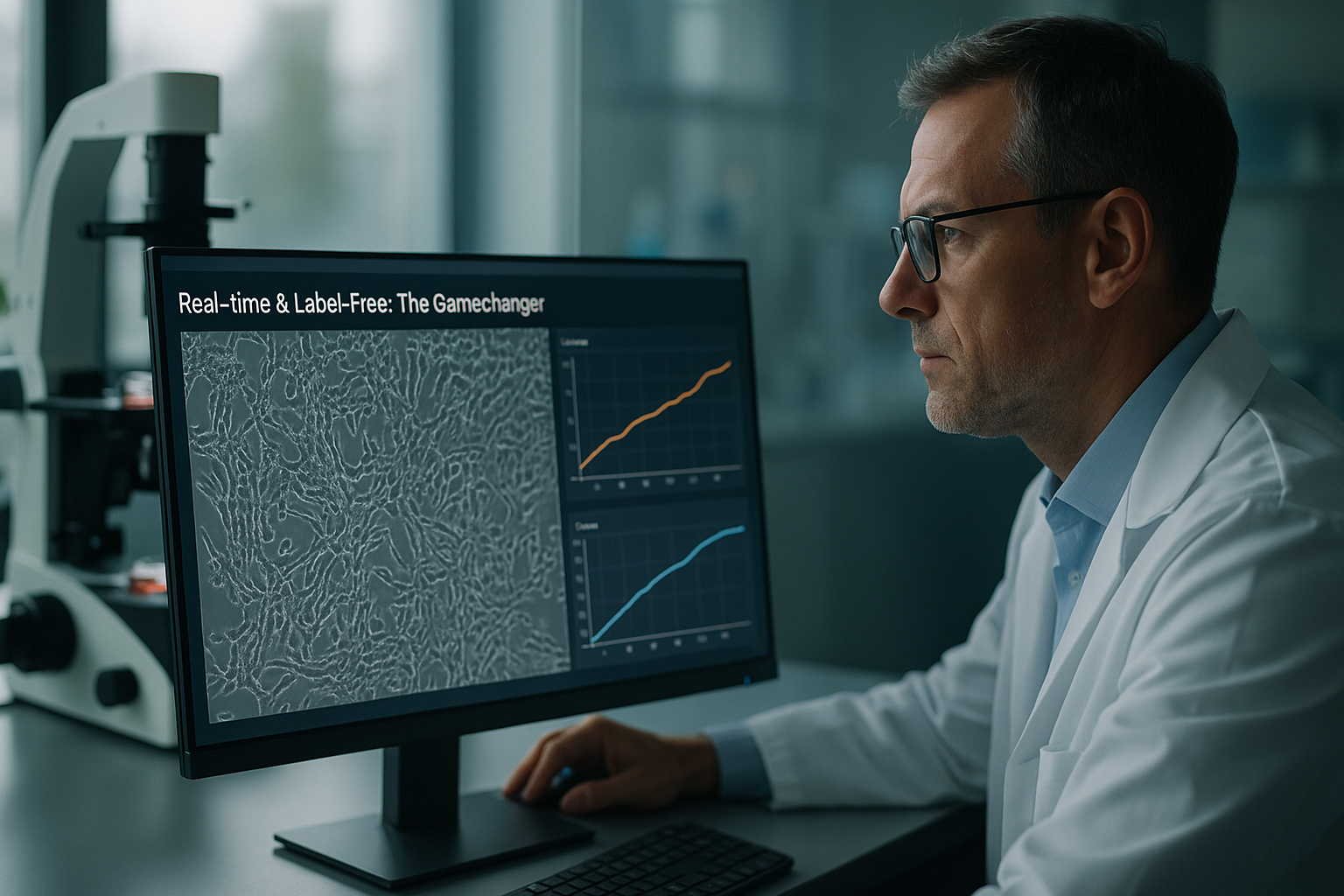
Real-time & Label-Free: The Gamechanger
In the ever-evolving field of cell culture research, the demand for more precise and efficient methodologies has led scientists to seek innovative solutions. Real-time and label-free technologies have emerged as pivotal gamechangers, revolutionizing how researchers conduct experiments and analyze data. The ability to monitor cellular processes continuously without invasive labeling not only enhances data accuracy but also streamlines laboratory workflows, enabling researchers to gain deeper insights into cellular dynamics.
This article delves into the relevance of real-time, label-free technologies in modern cell culture research, the challenges associated with traditional approaches, and the transformative impact of technological advances. It will also highlight practical examples using live-cell imaging and explore how these innovations are shaping the future of laboratory workflows.
Challenges and Limitations of Traditional Approaches
Traditional cell culture research often relies on endpoint assays and labeled methodologies, which, while effective, pose several limitations. One of the primary challenges includes the potential for phototoxicity and photobleaching during fluorescence imaging, which can affect cellular functions and lead to inaccurate data.
- Endpoint assays provide a snapshot rather than continuous data.
- Labeling agents can alter cellular behavior.
- Manual image acquisition risks data variability.
These limitations underscore the need for real-time and label-free imaging techniques, which offer continuous monitoring and eliminate the prerequisites of invasive labeling.
Technological Advances and Automation Trends
The integration of automation and real-time monitoring into cell culture research has marked a paradigm shift in the field. Systems like the zenCELL owl demonstrate how compact, incubator-compatible live-cell imaging systems can facilitate high-throughput data acquisition, increasing accuracy and reducing human error.
Emerging technologies now enable:
- Continuous, label-free monitoring of cellular processes.
- Automation of repetitive tasks, enhancing reproducibility.
- Advanced imaging modalities supporting high-resolution observation.
These technological advances present a gamechanger in facilitating robust, reproducible data collection and analysis.
Practical Examples and Workflows Using Live-Cell Imaging
Live-cell imaging offers researchers the capability to visualize and quantify cellular processes in real-time. The zenCELL owl system, for instance, allows uninterrupted monitoring of the cell culture environment, from proliferation to migration assays. This enables scientists to discern subtle cellular responses to experimental conditions dynamically.
Workflow Integration
The practical integration of automated imaging systems into standard laboratory workflows streamlines operations by reducing manual handling and human error, driving consistency across experiments.
- Enhanced tracking of cell health and morphology.
- Reduced variability through consistent imaging conditions.
Continue reading to explore more advanced insights and strategies.
„`html
Improving Data Accuracy with AI-Powered Analysis
Leveraging Artificial Intelligence in Real-Time Cell Monitoring
Incorporating artificial intelligence (AI) into real-time and label-free technologies represents a significant advancement in cell culture research. AI-powered analysis tools are now able to process vast datasets quickly and accurately, identifying complex patterns and trends that may not be visible to the human eye. For instance, machine learning algorithms can classify cellular images based on subtle morphological features, enhancing the predictive power of experiments.
- Utilize AI tools for systematic data extraction and interpretation.
Scalability and Cost-Efficiency in Cell Culture Labs
Making Advanced Tools Accessible and Economical
As technologies evolve, the cost-effectiveness and scalability of real-time, label-free systems have become compelling benefits for research facilities of all sizes. These innovations allow laboratories to monitor multiple samples simultaneously without the need for extensive human resources or financial investment. This democratization of technology paves the way for smaller labs to engage in high-level research.
- Implement scalable systems that fit budget constraints without compromising quality.
Enhancing Reproducibility in Experimental Research
Consistency Across Experimental Setups
One of the persistent challenges in experimental research is ensuring reproducibility. Automated real-time imaging systems standardize conditions across experiments, minimizing human error and subjective interpretation. Tools like the zenCELL owl can be calibrated to maintain identical imaging conditions, which significantly enhances the consistency of results across different trials and labs.
- Standardize imaging protocols to ensure replicable outcomes.
Enabling Remote Monitoring and Decision Making
The Future of Remote Laboratory Management
The integration of cloud connectivity with cell culture technologies allows researchers to monitor experiments remotely, facilitating real-time decision making. In scenarios where immediate action is necessary, such as unexpected changes in cell behavior, researchers can intervene promptly without physical presence in the lab. This capability is particularly beneficial in times of travel restrictions or when managing multiple locations.
- Adopt cloud-based monitoring for flexible and efficient research management.
Application-Specific Innovations
Tailoring Technologies to Research Needs
Real-time and label-free technologies are versatile and can be customized to meet specific research demands, whether in oncology, immunology, or drug development. For example, in oncology research, live-cell imaging assists in understanding tumor cell invasion and drug resistance mechanisms, providing crucial insights that traditional methods might miss.
- Customize imaging systems to cater to specialized research avenues.
Advancing Therapeutic Discoveries with Precision
Pioneering Novel Therapeutic Pathways
The precision enabled by real-time, label-free technology accelerates the discovery and testing of new drugs. By facilitating continuous observation of drug interactions with cellular processes, researchers can fine-tune therapeutic approaches with unprecedented precision. This methodology supports more targeted drug development, reducing the trial-and-error phase significantly.
- Leverage precision imaging to expedite the drug discovery pipeline.
Next, we’ll wrap up with key takeaways, metrics, and a powerful conclusion.
„`
„`html
Data-Driven Insights for Strategic Research
Enhancing Research Outcomes with Data Analytics
In the contemporary research landscape, data is a valuable commodity. The integration of advanced analytics tools in real-time and label-free technologies helps transform raw data into actionable insights. By leveraging these tools, researchers can explore hypotheses in more depth, identify underlying correlations, and generate predictive models that are crucial for sophisticated research endeavors. This data-driven approach not only bolsters scientific understanding but also enables research facilities to stay at the forefront of innovation.
- Deploy data analytics to uncover hidden scientific patterns that elevate research quality.
Fostering Interdisciplinary Collaboration
Breaking Silos for Holistic Scientific Advances
Interdisciplinary collaboration is key to solving complex scientific problems. Real-time, label-free systems foster such collaboration by allowing multiple research groups to share insights and develop a cohesive research strategy. Technologies supporting remote monitoring and cloud data sharing play a pivotal role in breaking down silos, thus driving integrative approaches across various fields. This collaborative model promotes a more comprehensive understanding of biological processes, encouraging innovations that might remain unexplored in traditional siloed settings.
- Encourage cross-disciplinary collaborations through shared technological platforms.
Navigating Ethical and Regulatory Boundaries
Addressing Ethical Considerations in Research
As scientific capabilities grow with the aid of real-time, label-free technologies, so does the importance of navigating ethical and regulatory boundaries. Maintaining strict adherence to ethical guidelines is paramount in ensuring that technological advancements are in line with societal norms and regulations. By embedding ethical considerations into the research process, stakeholders can ensure responsible use of these powerful technologies, allowing scientific progress to confidently step into uncharted territories while maintaining integrity and public trust.
- Align research practices with ethical guidelines to ensure responsible innovation.
Conclusion
As we’ve explored throughout this article, the advent of real-time and label-free technologies stands as a transformative force in the fields of cell culture labs and beyond. These cutting-edge systems offer a myriad of benefits, from improving data accuracy through AI-powered analysis to fostering cost-effectiveness and scalability in research settings. They are pivotal in ensuring consistency and reproducibility across experiments and have opened new avenues for remote monitoring, thereby allowing unprecedented flexibility in research management.
The advancements in customization and application-specific innovations highlight the technologies‘ versatility and capability to drive therapeutic discoveries with precision. By utilizing data-driven insights, these tools enable researchers to make strategic decisions informed by robust analytics, fostering a more insightful and effective research environment. The embrace of interdisciplinary collaboration and ethical considerations ensures that these technologies not only advance scientific knowledge but do so responsibly and inclusively.
As we stand on the cusp of scientific evolution, it is essential for researchers, institutions, and stakeholders to adopt these technologies and integrate them into their research frameworks. By doing so, they can propel their studies to new heights, make informed decisions, and contribute meaningfully to scientific and societal advancements. It is a call to action to embrace technology, spearhead innovation, and shape the future of research in a way that is both profound and progressive.
„`
 German
  English
Schreibe einen Kommentar