
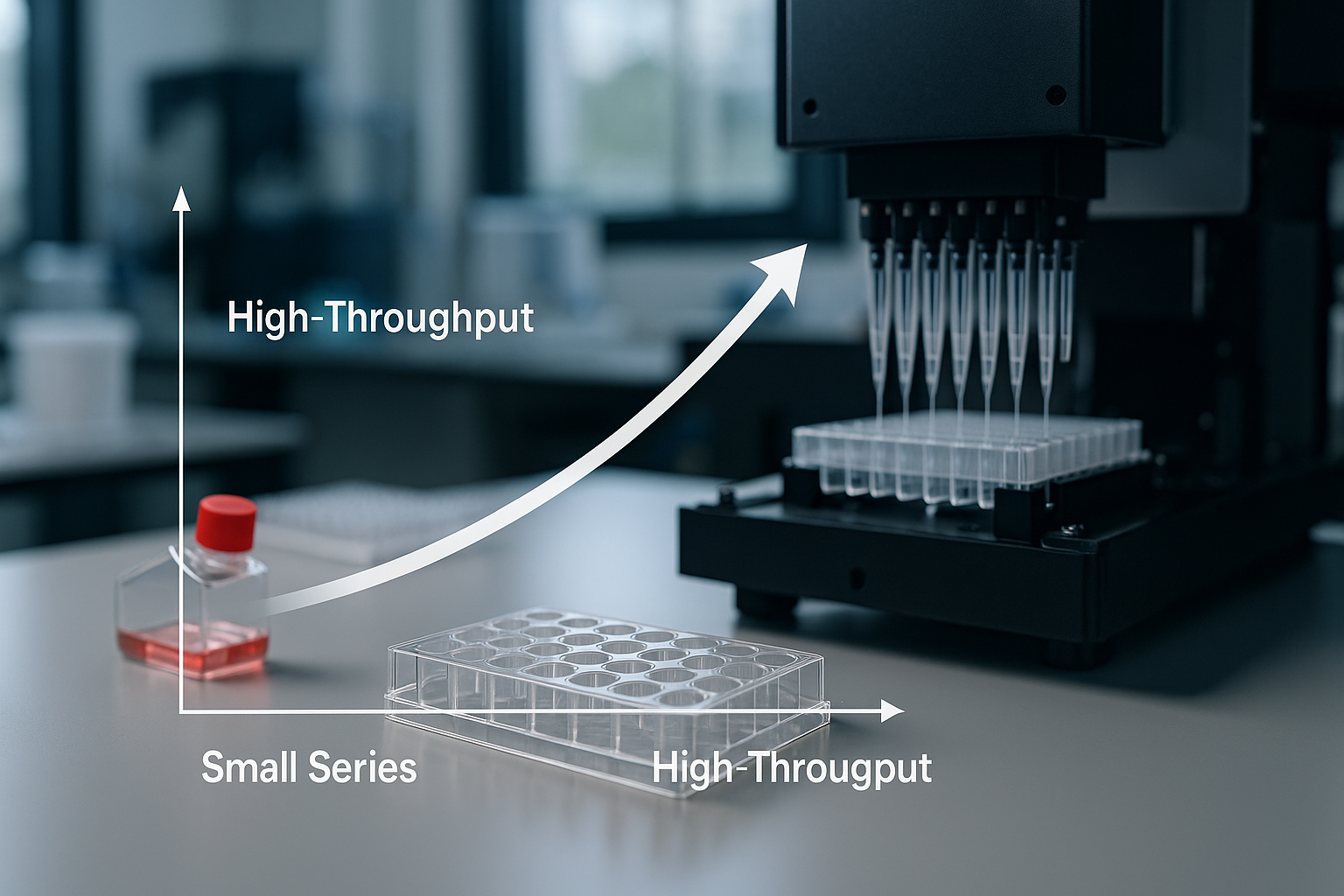
Scaling: From Small Series to High-Throughput
In the ever-evolving landscape of life sciences, the ability to scale from small batch production to high-volume throughput is pivotal for researchers and manufacturers. The dynamics of laboratory plasticware production, particularly for multiwell plates and cell culture vessels, demand a keen understanding of scaling intricacies. This article dissects the journey from design-by-prototype to scaled industrial production, addressing challenges and offering insights into maintaining quality and consistency in high-throughput scenarios.
Bridging the Gap: From Development to Manufacture
Advanced Product Development for Laboratory Plastics
The development of laboratory plastics, such as multiwell plates, is not merely about crafting a product; it’s about anticipating the demands of high-throughput applications. Key elements like Design-for-Manufacturing (DFM), material selection, and prototyping strategies play significant roles. Each component of the development phase shapes the trajectory toward scalable success.
- Utilizing design-for-manufacturing (DFM) principles ensures efficiency from the onset.
- Material choices such as polystyrene (PS), polypropylene (PP), and cyclic olefin copolymer (COC) directly influence product performance.
- Surface treatments, tailored for specific applications — from tissue culture (TC) treatments to specialty coatings — enhance biological and optical compatibility.
- Prototyping strategies serve as crucial checkpoints, illustrating the transition from concept to practical, scalable applications.
Tooling & Scaling: From Prototype to Production
Scaling in laboratory plasticware manufacturing hinges on the seamless transition through various stages of production. This includes early prototypes, pilot tooling, and ultimately, full industrial-scale tooling. Mastery of each phase ensures reproducibility, scalability, and robust processing necessary for large-scale manufacturing.
- The journey begins with prototypes that test design efficacy and manufacturing feasibility.
- Pilot tooling acts as a bridge, refining design and operations for pre-series production.
- Full-scale industrial tooling is executed with stringent controls to meet dimensional accuracy and process reliability.
Continue reading to explore more advanced insights and strategies.
„`html
Quality Assurance in High-Throughput Production
Maintaining Integrity and Reliability
As laboratory plasticware production scales up, maintaining product quality becomes increasingly challenging. Quality assurance strategies must be robust, incorporating in-line and post-production testing to ensure each product adheres to strict specifications. Employing statistical process control (SPC) methods throughout the manufacturing process is crucial for identifying defects early and minimizing waste.
- Implement real-time monitoring systems to capture data on critical production parameters, thus enabling rapid response to deviations.
Automation and Smart Manufacturing
The Role of Technology in Scaling
Automation plays a pivotal role in scaling manufacturing operations in the life sciences sector. As production scales, leveraging cutting-edge technologies—such as robotics and machine learning—can enhance efficiency and precision. For instance, implementing automated quality checks and robotic handling ensures constant throughput without compromising on quality, significantly reducing the potential for human error.
- Integrate digital twins to simulate production processes, allowing for real-time adjustments and predictive maintenance.
Managing Supply Chain Complexities
Ensuring Smooth Operations
As production scales, ensuring a robust supply chain becomes imperative. This involves strategizing material procurement and logistics to align with production timelines. Consider the case of a multinational biotechnology firm that optimized its supply chain by using advanced analytics to predict and mitigate potential disruptions, ensuring a consistent flow of raw materials like polymers and reagents vital for production.
- Develop strategic partnerships with suppliers to foster reliability and adaptability in your supply chain.
Environmental Considerations and Sustainability
Adopting Green Manufacturing Practices
Increased production rates often lead to increased environmental footprints. Therefore, incorporating sustainable practices is not only beneficial for compliance but also enhances brand reputation. Recycling and waste reduction initiatives are vital. Implementing closed-loop recycling systems for plastic waste, such as reusing production scraps, illustrates an effective strategy for reducing environmental impact.
- Invest in energy-efficient machinery and optimize processes to reduce carbon emissions.
Regulatory Compliance and Standards
Navigating Complex Requirements
Scaling production in the life sciences domain must align with stringent regulatory standards, such as ISO 13485 for medical device quality management systems. Ensuring compliance at every stage of manufacturing is paramount. For example, continuous documentation and adherence to FDA guidelines are critical for products marketed in the U.S., thereby avoiding costly recalls and safeguarding company reputation.
- Engage regularly with regulatory experts to remain abreast of any changes in compliance requirements.
Scalability and Flexibility: Dual Mandates
Balancing Demands for Large-Scale Operations
Achieving scalability without losing application-specific flexibility is crucial. Consider a company specializing in custom labware solutions that implemented modular production lines capable of quick reconfigurations to meet specific client needs. This approach has allowed them to maintain a competitive edge by offering customized solutions alongside standard high-throughput products.
- Design manufacturing processes with scalability in mind but retain the agility to switch production lines as required.
Investing in Workforce and Skills
Cultivating a Skilled Team for Success
The human element remains integral to successfully scaling production. Investing in workforce development through training initiatives ensures that employees are equipped to operate advanced manufacturing equipment and adapt to new technologies. A large-scale manufacturer, for example, successfully reduced error rates by 30% after implementing a comprehensive training program for their operators on new automated systems.
- Continuously upskill your workforce to keep pace with technological advancements and industry best practices.
Next, we’ll wrap up with key takeaways, metrics, and a powerful conclusion.
„`
„`html
Leveraging Data Analytics for Production Insights
Driving Informed Decision-Making
Data analytics has become an indispensable tool in optimizing high-throughput production. The life sciences industry can harness data-driven insights to refine operational strategies and enhance productivity. By aggregating data from various stages of the production line, manufacturers can gain a comprehensive overview of performance metrics and operational bottlenecks.
- Utilize advanced analytics platforms to interpret complex datasets, facilitating proactive decision-making in real-time.
Crisis Management and Risk Mitigation
Ensuring Business Continuity
In an industry characterized by rapid growth and innovation, preparing for unexpected challenges is critical. Developing a robust risk management plan ensures that potential disruptions to the production process are swiftly and effectively addressed. Companies equip themselves to maintain business continuity by identifying vulnerabilities and implementing contingency measures.
- Regularly conduct risk assessments and simulation drills to remain prepared for emergencies.
Future-Proofing Production Capabilities
Adapting to Evolving Market Demands
Future-proofing high-throughput production is vital as the life sciences market continues to evolve at an unprecedented pace. By investing in scalable technologies and fostering an innovation-driven culture, companies can adapt to shifting market trends and technological advancements, ensuring longevity and sustained growth.
- Regularly evaluate and update your production technology stack to align with cutting-edge innovations.
Conclusion
Successfully scaling production in the life sciences industry requires a multifaceted approach, as examined throughout this article. From implementing effective quality assurance measures and adopting advanced automation to managing complex supply chains and prioritizing sustainability, each aspect plays a crucial role in achieving efficient and sustainable growth.
Leveraging technology, whether through automation, data analytics, or digital twins, empowers manufacturers to maintain high standards of quality and operational efficiency. Meanwhile, investing in workforce skills and maintaining compliance with regulatory standards ensure that scaling efforts do not compromise product integrity or consumer trust.
Furthermore, integrating robust risk management practices and adopting scalable, flexible production models place companies in a strong position to adapt to market fluctuations and unforeseen challenges. As the industry grows, strategic foresight and adaptability will distinguish leaders from followers.
The strategies and insights presented herein are valuable for companies seeking to expand their operations while maintaining uncompromised quality and efficiency. By aligning cutting-edge production technologies with a skilled workforce and responsible environmental practices, businesses can thrive in this dynamic sector. The choice is clear: be at the forefront of innovation and sustainability by adopting these approaches.
Every step toward scaling production is a stride toward revolutionizing the life sciences industry and, ultimately, the broader goal of improving global health. We invite you to become a part of this exciting journey, pioneering change for a better future. Begin implementing these strategies today and witness the transformation in your operations.
„`
 German
  English
Schreibe einen Kommentar