
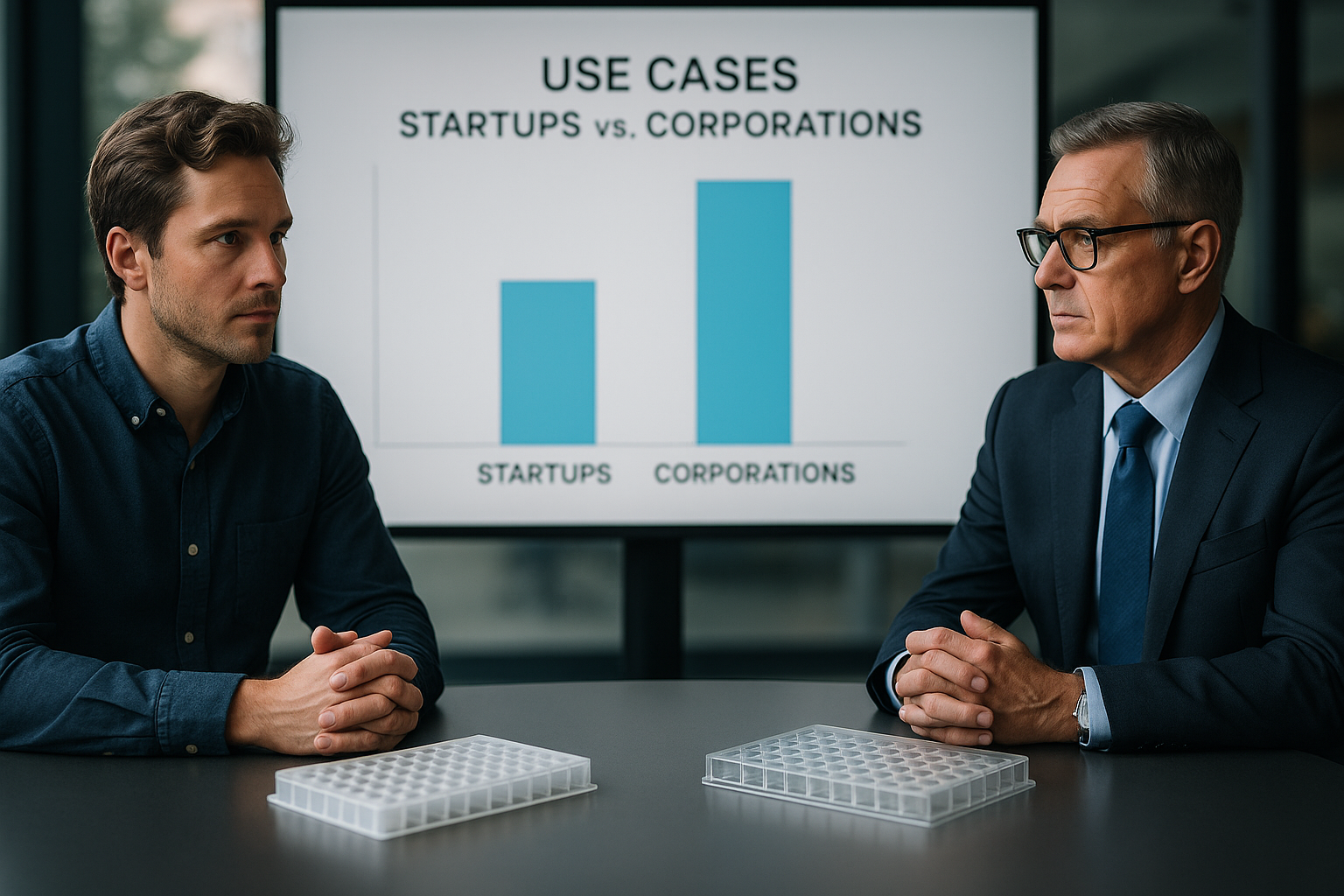
Use Cases: Startups vs. Corporations
In the realm of life sciences, the development and scaling of laboratory plasticware present unique challenges to both startups and well-established corporations. As product development and manufacturing strategies evolve, understanding the contrasts between processes in startups versus those in corporations is pivotal. Through this article, seasoned biotech professionals and researchers will explore the intricacies of product development, tooling, and manufacturing, focusing particularly on multiwell plates and advanced lab plastic products.
Product Development in Lab Plastics: Startups vs. Corporations
Design for Manufacturing and Material Selection
The development of laboratory plasticware such as multiwell plates and cell culture vessels necessitates rigorous design-for-manufacturing (DFM) principles. Startups often focus on agility and innovation, emphasizing rapid prototyping and iterative design. This is crucial for startups aiming to quickly validate novel designs with minimal investment. Conversely, corporations usually harbor extensive resources and experience, employing robust DFM processes that predict and solve production challenges.
- Startups typically leverage materials like polystyrene (PS) and polypropylene (PP) for cost-effective prototyping.
- Corporations may invest in advanced materials like cycloolefin copolymer (COC) for higher precision and clarity.
- Surface treatments such as tissue culture (TC) coatings are adapted to specific applications, pertinent in both environments.
Tooling and Scale-Up: From Innovation to Industrialization
Transitioning from Prototypes to Full-Scale Production
Tooling and scale-up stages are critical junctures in the lifecycle of lab plastics. Startups, in their drive for rapid market entry, rely on pilot tooling to refine designs and test market viability. This allows for nimble adaptations but with some limitations on scalability. On the other hand, corporations possess the machinery and expertise for full-scale production, ensuring larger volumes with impeccable reproducibility and dimensional accuracy.
- Evaluation of pilot tooling performance is vital for startups to meet initial demand without overcapitalizing.
- Corporations benefit from economies of scale and enhanced process robustness through advanced tooling solutions.
Injection Molding and Process Control Across Enterprises
Balancing Innovation with Consistency
Injection molding remains a cornerstone technology in labware manufacturing. For startups, mastering this process involves rigorous validation to guarantee consistency across small batches. With fewer resources, startups may rely on outsourcing or strategic partnerships to mitigate risks. In contrast, corporations foster dedicated in-house teams to maintain stringent control over critical process parameters, ensuring consistency across large volumes.
- Startups focus on cost-effective pilot production while developing proprietary process insights.
- Corporations standardize process validation, including documentation and traceability, in alignment with regulatory expectations.
cGMP and GMP Manufacturing Cultures: Navigating Regulatory Landscapes
Rigorous Compliance for Startups and Corporations
The adherence to cGMP and GMP guidelines is non-negotiable in the life sciences industry. Startups often find themselves adapting quickly to these requirements, sometimes struggling with resource constraints in implementing robust quality management systems. Corporations, however, typically integrate these regulatory frameworks seamlessly into their operations, having established batch documentation, change control measures, and extensive risk management protocols.
- Adopting risk-based approaches allows startups to prioritize regulatory compliance efficiently.
- Corporations benefit from established infrastructures that facilitate qualification and validation processes.
Small to Large Scale Production: Strategies Across Different Scenarios
Ensuring Flexibility and Supply Reliability
Production scalability is vital for manufacturers of laboratory plastics, irrespective of company size. Startups may cater to niche markets through customized solutions, providing flexibility and innovation advantages. Conversely, corporations ensure industrial production meets diverse global demands by employing scalable solutions that enhance supply reliability and lifecycle management of lab products.
- Startups thrive on agile manufacturing capabilities tailored to specific market needs.
- Corporations leverage long-term supply contracts to assure consistent market presence and product evolution.
Continue reading to explore more advanced insights and strategies.
„`html
Optimizing Supply Chain Management in Labware Production
Streamlined Partnerships and Just-in-Time Inventory
A robust supply chain is integral to effective labware manufacturing, whether in startups or corporations. Startups often utilize agile supply chains, creating partnerships with local suppliers for raw materials to reduce lead times and maintain flexibility. They might implement just-in-time (JIT) inventory systems to minimize waste and reduce holding costs. In contrast, corporations typically have well-established global supply chains capable of handling fluctuations in demand with sophisticated forecasting tools and significant buying power, ensuring superior supply chain resilience.
- Utilize digital tools like supply chain analytics to predict and adapt to changes in demand dynamically.
- Monitor supplier performance through KPIs to ensure quality and timeliness.
Implementing Sustainable Practices in Lab Plastic Manufacturing
Balancing Efficiency with Environmental Responsibility
Environmental sustainability is becoming increasingly critical in labware production. Startups often adopt eco-friendly materials and processes from inception, leveraging their smaller scale to experiment with biodegradable plastics or recyclable materials. Corporations, meanwhile, focus on improving the sustainability of existing processes by reducing energy use or emissions and integrating closed-loop systems for plastic waste. Real-world examples include transitioning to biodegradable bio-based polymer blends or implementing recycling programs for labware.
- Invest in R&D for sustainable materials to stay ahead in eco-friendly product offerings.
- Adopt life cycle assessment (LCA) tools to evaluate environmental impacts at all stages of production.
Technological Innovations Driving Labware Evolution
Emerging Technologies Propelling Next-Gen Lab Products
The labware industry continuously evolves with technological advancements, providing immense opportunities for innovation. Startups often serve as incubators for new technologies such as 3D printing, microfluidics, or smart materials like shape-memory polymers in labware designs. Corporations might focus on integrating smart technologies for real-time data tracking and digital integration with lab management systems. A case study of interest is Bioneer Corporation’s integration of IoT and AI technologies in automated labware systems, which can increase operational efficiency and accuracy.
- Encourage innovation through partnerships with tech companies and academic institutions.
- Employ pilot projects to test emerging technologies with minimal risk.
Leveraging Data Analytics in Labware Manufacturing
Enhancing Production Efficiency and Market Responsiveness
Data analytics is revolutionizing manufacturing workflows, including in the production of labware. Startups can use data-driven insights to optimize production processes and enhance decision-making, often employing cloud-based analytics platforms for cost-effective scaling. Corporations utilize big data analytics and machine learning to predict maintenance needs, improve production scheduling, and identify cost-saving opportunities. Insights like real-time monitoring and predictive analytics are especially impactful in optimizing downstream processes.
- Implement machine learning algorithms to predict production anomalies and ensure preventive maintenance.
- Utilize real-time dashboards for manufacturing KPIs to enhance visibility and responsiveness.
Integrating Digital Twins in Labware Production Processes
Virtual Simulations for Process Optimization
The digital twin concept offers a new paradigm in labware manufacturing by enabling virtual simulations of physical manufacturing setups to optimize production. Startups can use digital twins during the design phase to refine product features and manufacturing processes, significantly reducing development cycles. Corporations leverage comprehensive digital twin environments to conduct real-time simulations and predictive analysis, resulting in enhanced process reliability and time-to-market efficiency.
- Utilize digital twins to experiment with process iterations and predict the impact of changes without physical trials.
- Enable cross-team collaboration through shared virtual environments to foster innovation.
The Role of Artificial Intelligence in Quality Assurance
AI-Powered Quality Control for Precision and Efficiency
Artificial Intelligence (AI) is becoming a pivotal tool in quality assurance (QA) processes for labware manufacturing. Startups can implement AI-driven inspection tools to detect defects at an earlier stage, enabling lower-cost correction. These systems analyze images of labware products to identify anomalies beyond human perception capabilities. Meanwhile, corporations utilize AI within broader QA frameworks, including integrating with enterprise resource planning (ERP) systems for real-time batch tracking and compliance management.
- Adopt AI inspection technologies to reduce human error and increase QA throughput.
- Integrate AI insights with feedback loops in process improvements.
Next, we’ll wrap up with key takeaways, metrics, and a powerful conclusion.
„`
„`html
Customization and Tailored Solutions in Labware Production
Catering to Diverse Laboratory Needs
The capacity for customization is becoming increasingly important as laboratories seek tailored labware solutions to meet specific research needs. Startups excel in providing bespoke solutions owing to their flexibility and customer-centric approaches, often working closely with clients to iterate product designs through rapid prototyping and small-scale manufacturing. Corporations, armed with vast resources, offer custom solutions by leveraging modular component systems that can be easily adapted to various configurations. This dual strategy—startups focusing on niche customizations and corporations providing broad-scope modularity—ensures that diverse laboratory needs are accurately and efficiently addressed.
- Foster a customer-focused development process to ensure labware design aligns with client requirements.
- Invest in modular technology to enhance the adaptability of product lines.
Fostering a Culture of Continuous Improvement
Embracing Change for Long-term Success
A culture of continuous improvement is paramount in maintaining a competitive edge in labware manufacturing. Startups often have the advantage of a malleable company culture that embraces change and innovation, swiftly adapting to new market trends or technological advancements. They cultivate an environment where feedback loops are quick and effective. Corporations, while larger and potentially slower to change, drive continuous improvement through structured initiatives like Lean Six Sigma, enhancing operational efficiency and reducing waste. By employing a culture of Kaizen, labware manufacturers can ensure that each sector—be it production, R&D, or quality assurance—is perpetually aligned with evolving industry standards.
- Adopt methodologies like Agile and Lean to facilitate iterative improvement.
- Promote a mindset of adaptability and learning across all organizational levels.
Nurturing Workforce Skills for The Future
Developing Talent to Meet Industry Challenges
Investing in workforce development is critical to thrive in the rapidly evolving labware industry. Startups, often touted as talent incubators, offer dynamic roles that appeal to highly skilled innovators eager to implement cutting-edge methods. They focus on providing robust training programs in latest technologies and industry practices. In comparison, corporations prioritize comprehensive workforce planning, aligning skill development with strategic business goals and utilizing global resources for in-house training programs. Both entities understand that empowering employees with the right skills and knowledge is fundamental to maintaining innovation and competitiveness over the long term.
- Encourage skills development through cross-functional teams and continuous education programs.
- Leverage mentorship and collaborative projects to enhance learning opportunities.
Conclusion
The landscape of labware manufacturing is multifaceted, with both startups and corporations playing significant roles in shaping the future of the industry. Throughout this article, we’ve explored the diverse strategies employed across the spectrum. From refining supply chains to leveraging technological advancements such as AI and digital twins, each facet offers tangible value and opportunities for improvement.
Startups and corporations each bring unique strengths to the table. Startups thrive on agility and innovation, often leading the charge in adopting new materials, emerging technologies, and customized solutions to meet niche market demands. Meanwhile, corporations possess the infrastructure and resources necessary to implement large-scale changes and influence industry-wide standards. Together, these diverse elements contribute to an industry that is both flexible and forward-thinking, catering to the increasingly specialized needs of modern laboratories.
As we look forward to the future, it is imperative for all stakeholders within the industry to embrace a culture of continuous improvement, integrating sustainability and innovation into their core operational strategies. Building robust, adaptable, and customer-focused processes and fostering a skilled workforce are crucial in navigating the complexities of the modern labware landscape. The synergy between technological advancements and sustainable practices positions the industry not merely to respond to current challenges but to proactively shape a more resilient and efficient future.
Therefore, whether you’re part of a startup or a multinational corporation, now is the time to take bold steps. Integrate cutting-edge technologies, prioritize sustainability, and cultivate a workplace culture that champions progress and innovation. Through these efforts, we can ensure that labware manufacturing continues to evolve and meet the dynamic needs of the scientific community.
Let us commit to advancing our methodologies and remain inspired by the endless possibilities that lie ahead in labware manufacturing.
„`
 German
  English
Schreibe einen Kommentar