
SpecPlate - The better standard for plate-based UV/VIS spectroscopy | 4 measuring chambers, back injection principle
Revolutionary 96-well plate with 4 physical layer heights (100-2000 µm) - measures highly concentrated samples without dilution steps, eliminates meniscus problems, only 36 µl sample volume
The SpecPlate sets a new standard in plate-based UV/VIS spectroscopy. The unique Back-moulding principle fills 4 closed measuring chambers with defined layer heights (100 µm, 700 µm, 1400 µm, 2000 µm) via a single inlet - no meniscus, no pipetting errors, no dilution.
Manufactured by innoME in close development partnership with Phabioc - made of high-quality COC (cyclo-olefin copolymer) for UV transparency from 220 nm. ANSI/SLAS-compliant, compatible with all standard plate readers. Order directly from innoME Shop.
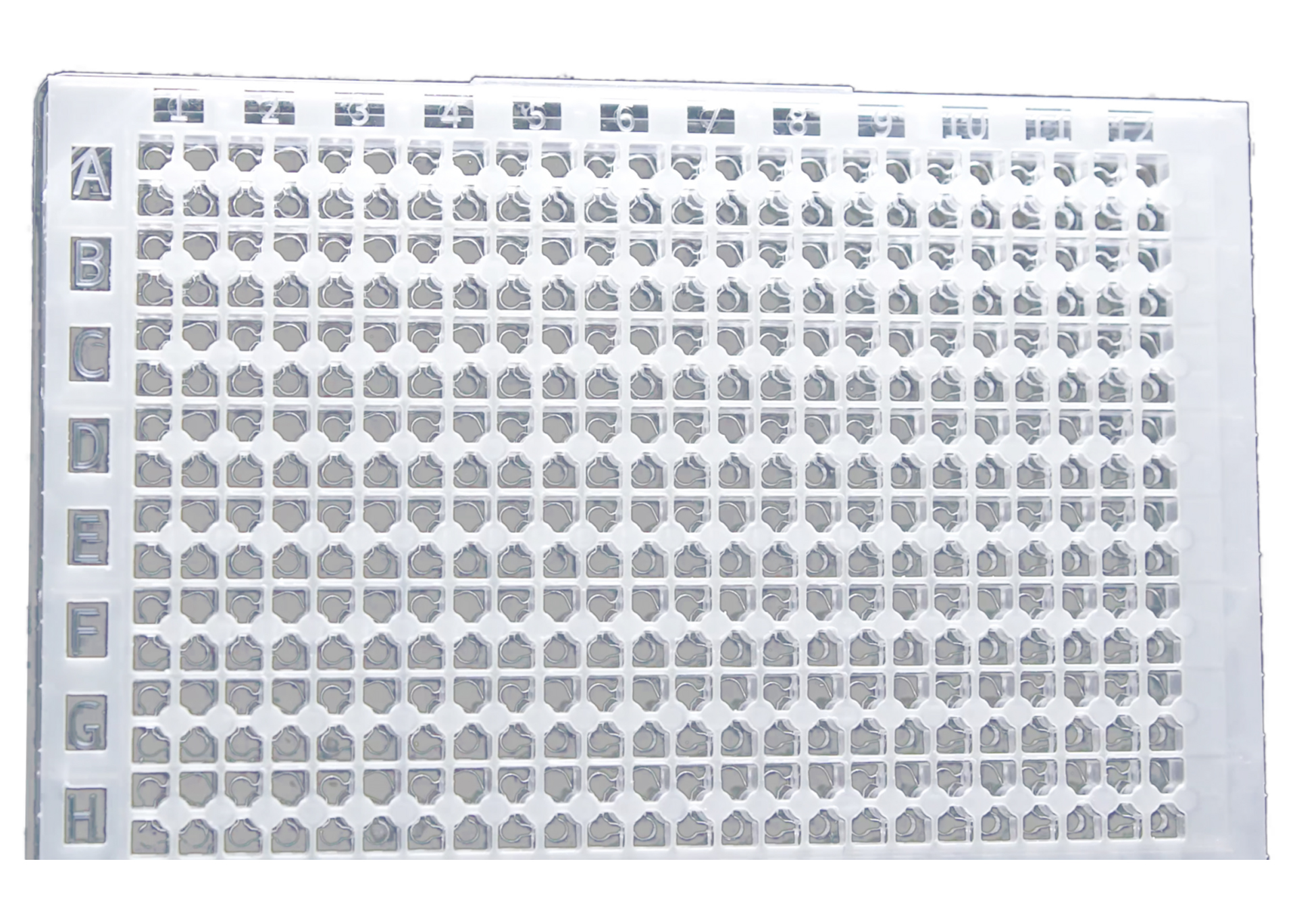
What makes the SpecPlate unique
The back-injection principle
Pipette the sample once - fill 4 layer heights simultaneously:
The sample is analysed via a single Inlet and flows through the 4 consecutive measuring chambers. The liquid rises in the inlet and outlet as a levelling vessel - the measuring chambers are completely filled, without a meniscus or air bubble. Pipetting errors are compensated for by the level equalisation chambers.
SpecPlate vs. standard plate
| Property | Standard 96-well | SpecPlate |
|---|---|---|
| Layer height | Variable (meniscus) | 4 × defined (100-2000 µm) |
| Measuring points/well | 1 | 4 (simultaneously) |
| Sample volume | 100-300 µl | 36 µl |
| Meniscus problem | Yes - Measurement error | No - closed chamber |
| Dilution necessary? | With high conc. | No |
| Pipetting errors | Affects measurement | Compensated (level vessel) |
| UV off | ~320 nm (PS) | 220 nm (COC) |
| Disc reader | 96-Well Reader | 384-well reader (standard) |
| Slope method | Not possible | Built-in - increased precision |
| Costs/data point | Standard | Up to 70% cheaper |
Product Information
The back injection principle - no menisci, no error
The 4 measuring chambers are connected via a single inlet Filled from behind - the sample flows through the cascaded chambers and rises in the inlet and outlet as communicating level vessels. The chambers are filled completely and bubble-free - without a meniscus at the measuring zone. This means that the light beam of the plate reader always hits a defined, flat liquid layer - no scattering, no measurement errors due to surface curvature. Even pipetting errors (±5 µl) are fully compensated for by the level equalisation chambers.
4 physically defined layer heights in one well
Each SpecPlate measuring structure contains 4 chambers with precisely defined heights: 100 µm, 700 µm, 1400 µm, 2000 µm. This physical „dilution“ through layer height variation completely replaces classic sample dilution:
100 µmVery high concentrations (which saturate the detector in standard plates) measurable
700 µmHigh concentrations without dilution
1400 µmMedium concentration range
2000 µmLow concentrations with maximum sensitivity
Result: 4 data points over a wide concentration range - simultaneously, from a single 36 µl sample.
Slope method - increased measurement accuracy through regression analysis
The 4 data points of the different layer heights enable the application of the Slope method (ascent method)Linear regression of the absorption values against the layer height results in a regression line (typically R² > 0.999). The slope of this line is proportional to the concentration - and more precise than a single measured value, as outliers are equalised by the regression.
Example: 5 mg/ml lysozyme measurement with SpecPlate → R² = 0.9995, y = 0.0011x + 0.0355. This statistical validation significantly increases the reproducibility compared to individual measurements in standard plates.
COC (cyclo-olefin copolymer) - the better material for UV/VIS
The entire SpecPlate is made from high-quality COC (Cyclo-Olefin-Copolymer) the proven material for spectroscopic applications in the UV range:
UV-transparent from 220 nmMeasurements at 220, 230, 260, 280 nm possible without problems (PS only from ~320 nm)
Solvent resistantResistant to DMSO, acetone and other organic solvents - important for drug discovery
Low inherent fluorescenceMinimal autofluorescence for precise fluorescence measurements
Low protein adsorptionMinimised sample losses at the plate surface
Seamless integration into standard workflows
The SpecPlate was developed strictly ANSI/SLAS Standards developed - no refitting, no new equipment necessary:
Inlet positions in 96-well formatStandard pipetting robots fill the SpecPlate like a normal 96-well plate
Reading window in 384-well formatStandard 384-well plate readers (Tecan, BioTek, PerkinElmer, BMG) read all 4 chambers automatically
Sealing film compatibleSpecial translucent sealing film available for volatile or toxic samples
Automation-readyDirect integration into high-throughput liquid handling systems
innoME as manufacturer - Phabioc as development partner
The SpecPlate is a joint product from innoME GmbH (Espelkamp) as a manufacturer and Phabioc GmbH as a development partner and sales organisation:
innoMEProduction of the SpecPlate in Germany - precision injection moulding of the COC structure with the 4 defined measuring chambers, quality assurance, packaging
PhabiocScientific development, characterisation, distribution, scientific support
Order: shop.innome.de
Enquiries for OEM or larger quantities directly to innoME.
Technical Specifications
Format (Inlet)
96-well arrangement (filling)
Format (read)
384-well arrangement (4 chambers × 96)
Layer heights
100 µm / 700 µm / 1400 µm / 2000 µm
Sample volume
36 µl (fills all 4 chambers completely)
Material
COC (cyclo-olefin copolymer) complete
UV transmission from
220 nm - full UV/VIS range
Solvent resistance
DMSO, acetone, organic solvents
Standard
ANSI/SLAS compliant
Disc reader
All standard 384-well readers (Tecan, BioTek, PerkinElmer, BMG)
Sealing film
Optional - translucent for volatile samples (Art. 400101)
Packaging
40 pieces/box (Art. 400100)
Manufacturer
innoME GmbH, Germany | Distribution: Phabioc
Applications
Wherever UV/VIS measurements need to be precise, fast and cost-effective:
- Protein quantification (A₂₈₀) at high concentrations
- DNA/RNA quantification (A₂₆₀) - direct, without dilution
- Protein purity (A₂₈₀/A₂₃₀ ratio)
- Drug Discovery - Drug absorption at 220-300 nm
- Enzyme kinetics in the UV range (samples containing DMSO)
- Quality control in Biotech & Pharma
- Process analytics - High number of samples, fast throughput
Further links
More about SpecPlate and related products:
Advantages at a glance
Back injection - no meniscus, no measurement error
4 layer heights simultaneously - wide concentration range
No dilution steps - highly concentrated direct measurement
Only 36 µl - 4× less sample volume than standard
UV from 220 nm - COC is UV-transparent, PS is not
Manufactured by innoME - in Germany, precision injection moulding
FAQ - SpecPlate
„Back injection“ means that the sample is injected over a single Inlet channel pressed into the 4 measuring chambers from behind becomes. The sample flows through the cascaded chambers (2000 µm → 1400 µm → 700 µm → 100 µm) and rises in the inlet and outlet as communicating level vessels. The measuring chambers are filled completely and bubble-free - without a liquid meniscus on the light transmission surface. This eliminates the largest measurement error in standard microtitre plates.
In standard plates there is only one layer height (~1 cm). If the sample is too concentrated, the detector saturates - you have to dilute and measure again. The SpecPlate has 4 physically different layer heights (100-2000 µm) in the same well. Highly concentrated samples are in the detection range in the 100 µm chamber - at the same time, lower concentrations are precisely measured in the 2000 µm chamber. No dilution, no error, no extra work.
Yes - the SpecPlate is ANSI/SLAS-compliant and is used with a standard 384-well disc reader (the 4 chambers × 96 wells = 384 read positions). Compatible with Tecan, BioTek, PerkinElmer, BMG Labtech, Molecular Devices and all other 384-well-capable devices. It is filled like a normal 96-well plate - pipetting robots work without adaptation.
The 4 layer heights provide 4 absorption values for the same sample. If these are plotted against the layer height (X-axis: µm, Y-axis: absorbance), a straight line with typical R² > 0.999 results. The gradient of this straight line is proportional to the concentration - according to the Lambert-Beer law (A = ε × c × d). This regression analysis significantly increases precision compared to individual measurements and compensates for outliers. Phabioc offers webinars on practical application.
The SpecPlate (Art. 400100, 40 pieces/box) is available directly in the innoME Shop available: shop.innome.de. For larger quantities, OEM enquiries or special conditions, please contact the innoME GmbH as a manufacturer.
 German
  English