
Buy 12-Well Plates – TC-treated & sterile | Cell culture disposables | innoME
12-Well Cell Culture Plates for Transfection, Luciferase Assay, Differentiation & Virus Production – TC-treated, sterile, USP Class VI Polystyrene
The innoME 12-Well Plates bid with 3.8 cm² growth area per wave the ideal balance between sufficient cell material and an efficient sample count. The recommended medium volume of 1.2 to 1.9 ml per well makes the 12-well format the standard for transfection experiments, reporter gene assays, and differentiation studies.
Made from USP Class VI medical-grade polystyrene — Gamma-sterilised (SAL 10⁻⁶), endotoxin-free, DNase-free, RNase-free. TC-treated surface for optimal cell adhesion. SBS-compliant external format for all laboratory automation systems.
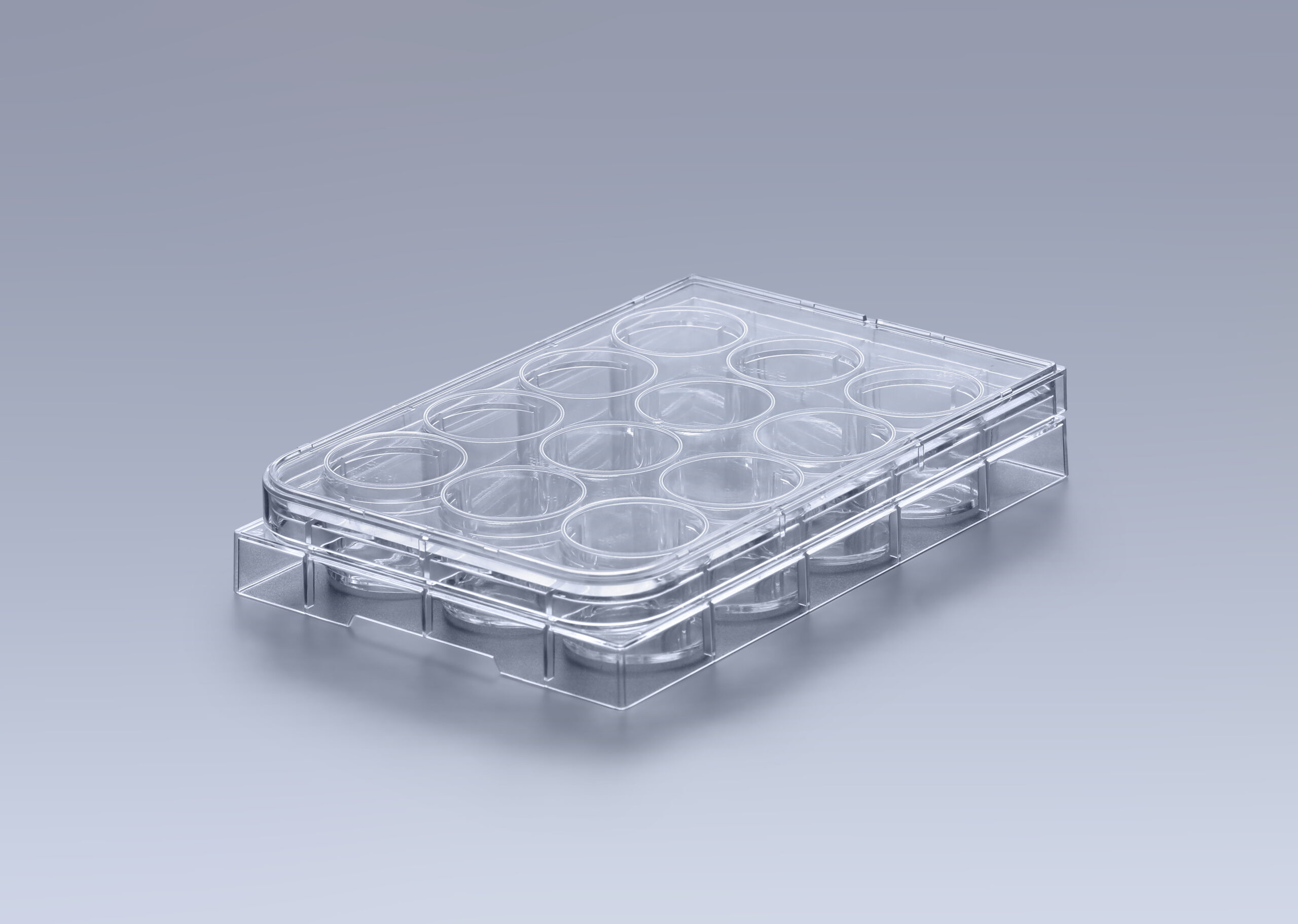
Applications of the 12-well plate
Transfection
The 12-well format is the preferred transfection format when more replicates are required than the 6-well format can accommodate — whilst ensuring there is sufficient cell material for downstream analyses. Compatible with all standard transfection reagents (Lipofectamin 3000, JetOPTIMUS, PEI). Recommended cell count: 1–3 × 10⁵/well (HEK293T, HeLa, CHO).
Luciferase and Reporter Assays
Standard format for luciferase reporter gene assays — sufficient lysate for dual luciferase measurement (Firefly + Renilla). Typical: 100–200 µl Passive Lysis Buffer per well for complete lysis. The 12-well provides significantly more signal than 24- or 96-well formats.
Differentiation
Differentiation protocols (neuronal, osteogenic, adipogenic, chondrogenic) require sufficient surface area and volume to allow for media changes without causing cell stress. The 12-well format is the standard for MSC differentiation, iPSC neuronal differentiation and cardiomyocyte maturation.
qRT-PCR preparation
Sufficient RNA yield for qRT-PCR from a single well: typically 1–5 µg total RNA from confluent cells in a 12-well format. Direct lysis with RLT/TRIzol in the well. More efficient than combining several 24-well plates.
Virus production
Small-scale lentiviral and adenoviral vector production. 12-well format for virus production when less supernatant than in 6-well is sufficient — or for parallel condition testing (MOI optimisation, transfection reagent comparison).
Immunofluorescence
12-well plate with coverslips (13 mm or 18 mm round coverslips fit into one well) for immunofluorescence and confocal microscopy. The standard choice for colocalisation studies, antibody validation and morphological analysis of adherent cells.
Technical Specifications
Number of wells
12 wells (3×4 arrangement)
area for expansion
3.8 cm² per wave
Recommended volume
1.2 – 1.9 ml per well
Well diameter
22.1 mm
Soil type
Flat Bottom
Material
USP Class VI polystyrene (PS)
Surface
TC-treated (vacuum plasma)
Sterilisation
Gamma-irradiated, SAL 10⁻⁶
Endotoxin
Endotoxin-free, pyrogen-free
Lid
With lid, ventilated
Colour
Transparent
Packaging
1 tray/bag, sterile packaging
Which format is the right one?
Comparison of all innoME multi-well plate formats — the 12-well plate is highlighted:
| Format | Growth area/wave | Rec. Vol/Wave | Typical application |
|---|---|---|---|
| 6-Well | 9.5 cm² | 2.2–4.5 ml | Primary cells, organoids, transfection |
| 12-Well | 3.8 cm² | 1.2–1.9 ml | Transfection, luciferase, differentiation |
| 24-Well | 1.9 cm² | 0.55–0.88 ml | TEER, Drug Screening, Scratch Assay |
| 48-Well | 0.95 cm² | 0.19–0.48 ml | Miniaturised screening, Cytokines |
| 96-Well | 0.32 cm² | 0.1–0.2 ml | HTS, ELISA, Proliferation assays |
Why innoME 12-well plates?
USP Class VI medical polystyrene – highest purity, no cytotoxicity
Gamma-sterilised (SAL 10⁻⁶) – endotoxin-free, DNase-free, RNase-free
TC-treated surface – optimal cell adhesion for adherent cell lines
SBS/ANSI-compliant format – compatible with all plate readers & robots
Available from stock – fast availability, no minimum order quantity
Compatible with zenCELL owl – Live cell imaging directly in the plate
FAQ – 12-Well Plates
Typical seeding: 1–3 × 10⁵ cells/well for fast-growing lines (HEK293T, HeLa, A549). For primary cells: 0.5–1 × 10⁵/well. Confluence after 24h for transfection, after 48–72h for differentiation protocols. Maximum capacity approx. 2 × 10⁶ confluent cells/well.
Round coverslips with a diameter of 12 mm or 13 mm fit perfectly into a 12-well plate (inner diameter 22.1 mm). For optimal bottom coverage: 18 mm coverslips are possible but a tight fit. Sterilise coverslips before use (ethanol + UV or autoclaving).
Yes — for FACS analyses, culture cells in 12-well plates, trypsinise, and transfer to FACS tubes. A confluent 12-well plate typically yields 1–3 × 10⁶ cells — sufficient for multi-parameter immunophenotyping.
From confluent adherent cells (HeLa, HEK293T): typically 2–8 µg total RNA per well with standard column purification (RNeasy). With TRIzol extraction: up to 15 µg. Sufficient for multiple qRT-PCR reactions and RNA sequencing.
Related products
Other innoME products that are a good fit for the 12-well plate:
 German
  English