
Buy Erlenmeyer flask – PETG & PC, Seal Cap & Vent Cap, sterile, cGMP
Sterile disposable Erlenmeyer flasks for cell culture, fermentation and biopharmaceutical production – 125 ml to 5 L
The innoME Erlenmeyer flask are designed for maximum reproducibility in cell culture, biopharma and research workflows. Suspension cultures, fermentation and biopharmaceutical workflows developed. Choose from 9 variants — Standard or protection, PETG or PC, Seal Cap or Vent Cap — the optimal solution for every application.
All pistons made of high-quality PETG or PC according to USP Class VI, gamma-irradiated (SAL 10⁻⁶), DNase-free, RNase-free, endotoxin-free, cGMP compliant. Closure cap made of high-strength PP — Vent cap with 0.2 µm PTFE hydrophobic breathable membrane.
Available from stock 1–3 working days To the EU. No import fees.
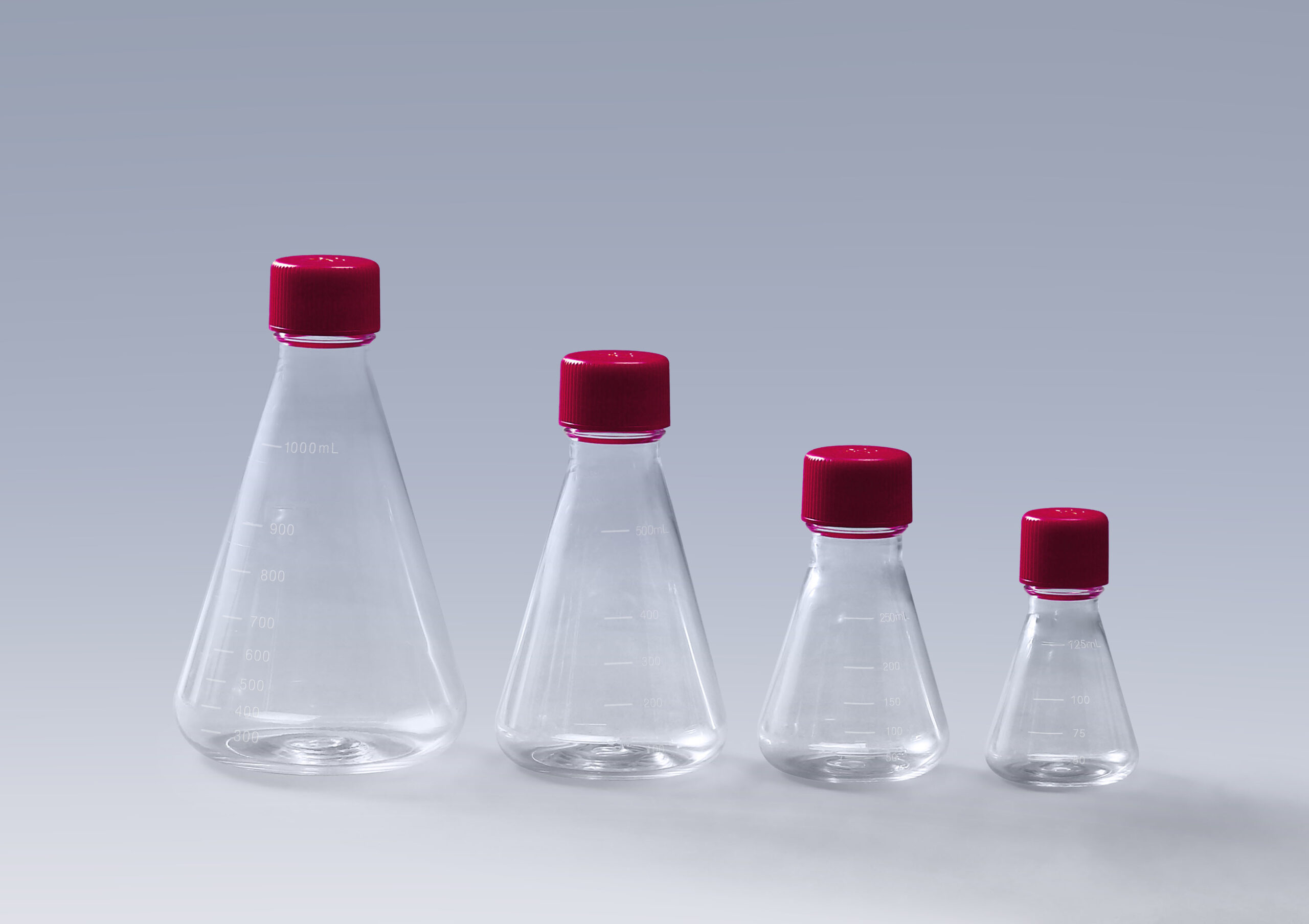
All Erlenmeyer flask variants
9 variations for every process – choose material, closure and volume:
PETG Erlenmeyer Flask Seal Cap
- 125 ml, 250 ml, 500 ml, 1,000 ml
- Gas-tight seal
- Ideal for transport and anaerobic processes
- Gamma-irradiated, sterile, USP Class VI
PETG Erlenmeyer flask vent cap
- 125 ml, 250 ml, 500 ml, 1,000 ml
- 0.2 µm PTFE breathable membrane
- Ideal for aerobic shake cultures
- Gamma-irradiated, sterile, USP Class VI
PC Erlenmeyer Flask Seal Cap
- 125 ml, 250 ml, 500 ml, 1,000 ml
- Gas-tight seal
- Autoclavable up to 125°C
- Gamma-irradiated, sterile, USP Class VI
PC Erlenmeyer flask vent cap
- 125 ml, 250 ml, 500 ml, 1,000 ml
- 0.2 µm PTFE breathable membrane
- Autoclavable up to 125°C
- Gamma-irradiated, sterile, USP Class VI
Schikanepiston PC Seal Cap
- 125 ml, 250 ml, 500 ml, 1,000 ml
- 4 Baffles – improved O₂ transfer
- Gas-tight seal, autoclavable
- Gamma-irradiated, sterile, USP Class VI
Trivial Piston PC Vent Cap
- 125 ml, 250 ml, 500 ml, 1,000 ml
- 4 strainers + 0.2 µm PTFE membrane
- Maximal O₂ input, autoclavable
- Gamma-irradiated, sterile, USP Class VI
PC Erlenmeyer flasks 3 L & 5 L
- 3 L and 5 L volume
- Seal cap or vent cap selectable
- Autoclavable up to 125°C
- For scale-up & pilot production
Erlenmeyer flask 2-port tubing system
- 250 ml, 500 ml, 1,000 ml
- 2 Silicone tubes + Luer connectors
- For closed process chains
- Gamma-irradiated, fully sterile
Erlenmeyer flask 3-port tubing system
- 250 ml, 500 ml, 1,000 ml
- 3 Silicone tubes + Luer connectors
- For complex closed processes
- Gamma-irradiated, fully sterile
Which Erlenmeyer flask is right for me?
| Variant | Material | Sealing | Autoclavable | Oxygen input | Volumes | Ideal for | Article No. |
|---|---|---|---|---|---|---|---|
| PETG Seal Cap | PETG | Gas-tight | No | Gearing | 125–1000 ml | Transport, storage, anaerobic | C030xxx |
| PETG Vent Cap | PETG | 0.2 µm PTFE | No | Very good | 125–1000 ml | CHO, HEK293, Insect cells | C031xxx |
| PC Seal Cap | PC | Gas-tight | Yes (125°C) | Gearing | 125–1000 ml | Reuse, anaerobic | C032xxx |
| PC Vent Cap | PC | 0.2 µm PTFE | Yes (125°C) | Very good | 125–1000 ml | Aerobic cultures + autoclaving | C033xxx |
| PC Seal Harassment | PC | Gas-tight | Yes (125°C) | Gut | 125–1000 ml | Aerobic cultures, transport | C034xxx |
| Harassment PC Vent | PC | 0.2 µm PTFE | Yes (125°C) | Maximal | 125–1000 ml | E. coli, yeast, high oxygen demand | C035xxx |
| 3 L & 5 L PC | PC | Seal or vent | Yes (125°C) | Very good | 3 L / 5 L | Scale-up, Pilot production | — |
| 2-Port System | PETG/PC | 2x Silicone | Upon request | Means | 250–1000 ml | Closed processes, GMP | — |
| 3-Port System | PETG/PC | 3 x Silicone | Upon request | Means | 250–1000 ml | CGT, Biopharma, aseptic | — |
Product Information
PETG vs. PC – which material do I need?
PETG (Polyethylene Terephthalate Glycol-modified) offers excellent chemical transparency, high resistance, and is ideal for standard cell culture and suspension applications. Not autoclavable.
Polycarbonate autoclavable up to 125°C — ideal when repeated thermal sterilisation is required or the flask is to be sterilised after initial use. Both materials USP Class VI.
Seal Cap vs. Vent Cap – what's the difference?
Seal Cap is completely gas-tight — ideal for transport, storage, and anaerobic processes. No gas exchange, no risk of evaporation.
Vent Cap contains an integrated 0.2 µm PTFE hydrophobic breather membrane — continuous gas exchange (O₂ in, CO₂ out) during shaking while microorganisms are retained. Ideal for aerobic suspension cultures.
Baffled flask – when is it useful?
Harassment pistons have 4 moulded ribs (baffles) which create turbulence during agitation and significantly increase gas exchange (O₂-input) compared to standard pistons. Additionally, liquid shearing is increased, which reduces cell clumping.
Recommendation Harassment piston for highly aerobic cultures (E. coli, yeasts, insect cells with high O₂ requirements). Standard flasks for CHO, HEK293, and cultures with moderate O₂ requirements.
2-Port & 3-Port Hose Systems – for Closed Process Chains
Multi-Port Erlenmeyer flasks allow Sterile medium transfer, sampling and gas exchange without opening the flask. All silicone hoses with Luer connectors for connection to pumps, sensors and transfer sets.
2-PortTwo independent connections – ideal for simple, closed process chains (inlet + outlet).
3-PortThree ports — for complex CGT processes and aseptic biopharmaceutical applications.
Sterility & Certificates
All innoME Erlenmeyer flasks are gamma-irradiated (SAL 10⁻⁶), sterile, DNase-free, RNase-free, pyrogen-free, endotoxin-free and according to USP Class VI Certified. The scaling is clear and accurate for simple volume control. No animal contact, no pyrogenic components. Batch-related certificate available on request.
cGMP Production
All pistons are under Current Good Manufacturing Practice (cGMP) conditions Manufactured – no direct contact with personnel, consistent product quality, complete traceability. Suitable for pharmaceutical research, pilot production and biopharmaceutical manufacturing. OEM and private label production available on request.
Technical Specifications (all variants)
Standard volumes
125 ml, 250 ml, 500 ml, 1,000 ml
High volume
3 L, 5 L (High Efficiency PC)
Height (125 ml)
115.8 mm | Neck Ø: 29.4 mm | Base Ø: 66 mm
Height (1,000 ml)
216.8 mm | Neck: 39 mm | Bottom: 127 mm
Materials
PETG or PC (Polycarbonate), USP Class VI
End caps
PP – Seal Cap (gas-tight) or Vent Cap (0.2 µm PTFE)
PC Autoclavability
Up to 125°C
Sterilisation
Gamma radiation, SAL 10⁻⁶
Certificates
DNase-free, RNase-free, pyrogen-free, endotoxin-free
Packaging
24 units/carton (125 ml) / 12 units/carton (250–1000 ml)
Production
cGMP-compliant, no direct contact with personnel
Origin
German warehouse, no import fees, 1–3 days
Advantages
9 variants – the optimal solution for every application
PETG & PC – both materials USP Class VI
PC autoclavable up to 125°C – repeated sterilisation
Vent Cap 0.2 µm PTFE – Gas exchange without contamination
Aeration methods for maximum O₂ intake
German Warehouse – 1–3 Day Delivery, No Import Charges
FAQ – Frequently Asked Questions about Erlenmeyer flasks
PETG offers excellent transparency, high chemical resistance and is more economical — ideal for standard disposable processes. Not autoclavable.
Polycarbonate Autoclavable up to 125°C — necessary if the flask needs to be sterilised multiple times or if the process requires autoclaving. Both USP Class VI, both available gamma-irradiated.
Intimidation pistons are useful if your culture has a high oxygen demand hat. The 4 moulded ribs create turbulence when shaken, which significantly improves O₂ transfer and mixing. Typical applications: E. coli, Yeasts (S. cerevisiae, P. pastoris), Bacillus and other highly aerobic organisms. For CHO, HEK293 and mammalian cells, a standard flask is usually sufficient.
As a rule of thumb, we recommend 20–251% of the nominal volume Recommended working volumes for optimal gas exchange during shaking: 125 ml flask → 25–30 ml, 250 ml → 50–60 ml, 500 ml → 100–125 ml, 1,000 ml → 200–500 ml. With baffled flasks, you can increase the working volume up to 30%.
Multi-Port pistons (2-port or 3-port) are ideal when you sterile media transfer or sampling without opening require - typically in cGMP processes, CGT applications and aseptic biopharmaceutical manufacturing. The silicone tubes with Luer connectors allow direct connection to pumps, sensors and transfer sets. For open pouring in the laboratory, a standard flask is sufficient.
Yes — innoME offers OEM and private label production For Erlenmeyer flasks: individual volumes (from 50 ml to 10 L), special closure concepts, custom graduations, your own branding, and tailored packaging solutions. Tooling lead time approx. 3 months. Contact us for a quote.
 German
  English