
„`html
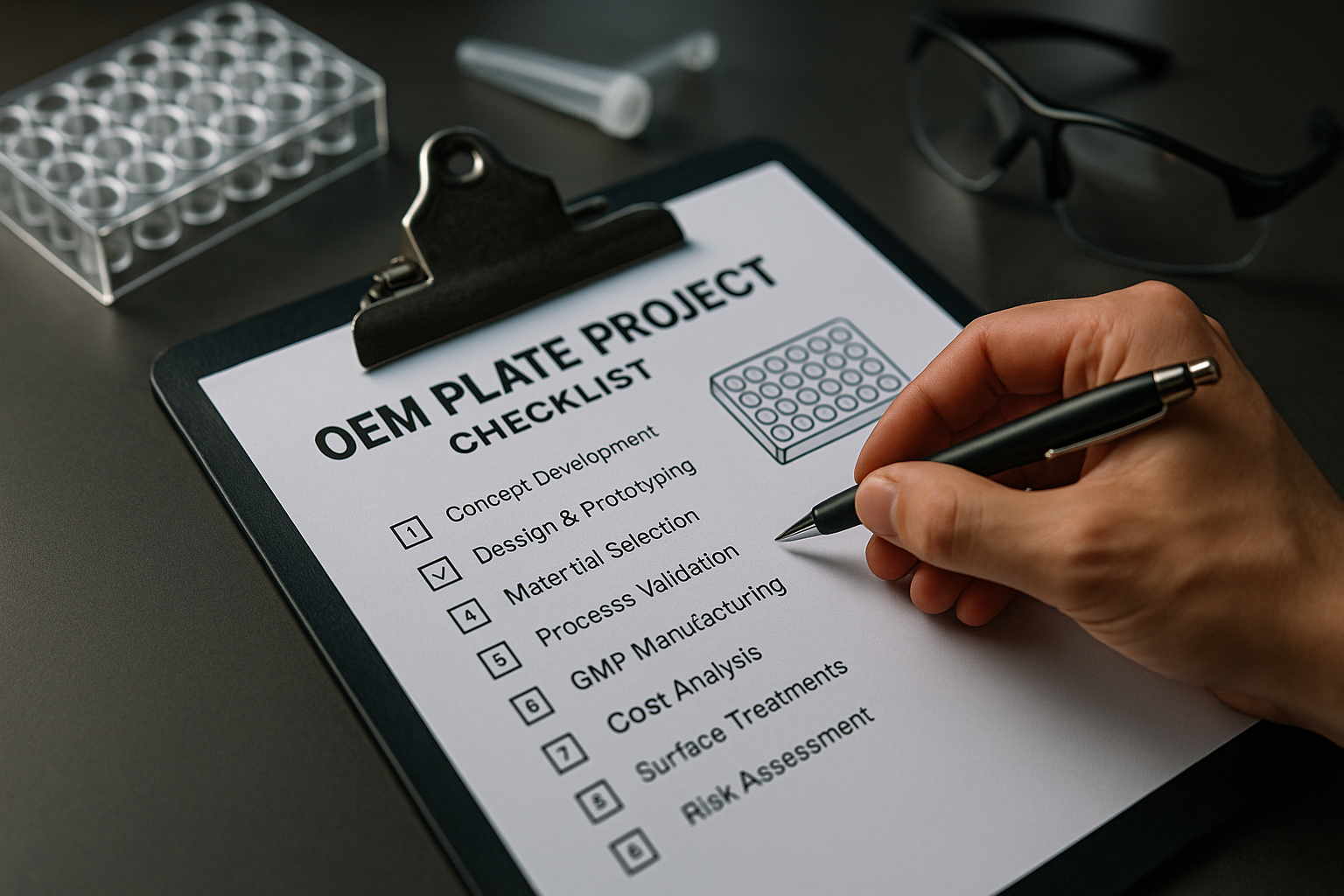
OEM Plate Project Checklist
In the evolving landscape of life sciences, the development and production of customized laboratory plastics, particularly OEM multiwell plates, play a pivotal role. Researchers, lab managers, and biotech professionals seek high-precision, application-specific solutions to advance their work. This comprehensive guide delves into the crucial phases of OEM plate project execution, from initial concept to GMP manufacturing, ensuring researchers are equipped with the knowledge to meet their specific scientific and manufacturing goals.
Introduction: The Relevance of OEM Plate Projects in Modern Research
The surge in advanced cell culture techniques and high-throughput screening has prompted a need for innovative laboratory plasticware designed for specialized applications. OEM multiwell plates, hence, are central to this requirement, becoming the backbone of numerous applications in diagnostics and pharmaceutical research. This article elucidates the systematic approach required to conceptualize, develop, and manufacture these plates, addressing critical aspects such as Design-for-Manufacturing (DFM), material selection, process validation, and adherence to GMP standards.
Product Development – Lab Plastics
Design-For-Manufacturing (DFM) Approach
The early stages of OEM plate projects involve meticulous planning and robust design strategies. The design-for-manufacturing approach ensures that prototypes are not only fit for purpose but also viable for scale-up in production. This involves:
- Analyzing the desired application and functional requirements.
- Incorporating ergonomic designs for ease of use and automation compatibility.
- Consulting manufacturing constraints early to mitigate risks during production.
Material Selection
The choice of materials is crucial for the integrity and functionality of laboratory plates. Common options include:
- Polystyrene (PS) for its excellent optical properties.
- Polypropylene (PP) for enhanced chemical resistance.
- Cyclic Olefin Copolymer (COC) for biocompatibility and optical clarity.
Material selection impacts the plate’s mechanical strength, surface texture, and suitability for surface treatments such as tissue culture (TC) treatments.
Prototyping Strategies
Efficient prototyping can significantly cut down the time-to-market for OEM multiwell plates. Options include rapid prototyping techniques like 3D printing for early-stage models and CNC machining for more mature designs that closely resemble the final product.
Continue reading to explore more advanced insights and strategies.
„`
„`html
Process Validation and Quality Assurance
Ensuring Stringent Standards in Production
Process validation is a fundamental aspect of OEM plate development, focusing on establishing documented evidence that a manufacturing process is consistent and able to produce a product that meets predetermined specifications. This phase involves rigorous testing and verification of processes:
For instance, implementing a strategy that incorporates Installation Qualification (IQ), Operational Qualification (OQ), and Performance Qualification (PQ) can streamline this effort. Continual monitoring and quality control checks must be enforced to detect variations or deviations.
- Perform regular audits and traceability checks to ensure compliance with ISO standards.
- Use Statistical Process Control (SPC) systems to monitor and regulate product throughput.
GMP Compliance: The Gold Standard
Adhering to Good Manufacturing Practices
Good Manufacturing Practice (GMP) compliance is non-negotiable in the production of OEM plates. It ensures products are manufactured consistently and meet quality standards appropriate for their intended use. Embracing GMP in production involves:
Real-world examples demonstrate the importance of cleanliness and hygiene in contamination-sensitive environments, underlining the protocol adherence necessary in facilities working on high-impact medical research tools. Automating record-keeping and batch analysis to eliminate human error is proving highly effective.
- Develop comprehensive Standard Operating Procedures (SOPs) for each stage of production.
- Implement robust training programs for personnel to ensure procedural knowledge and compliance.
Cost-effective Manufacturing Solutions
Balancing Innovation with Budget Pressures
The financial viability of introducing new OEM plates is crucial. Cost management strategies such as Just-In-Time (JIT) production and lean manufacturing can help mitigate expenses while maintaining high output standards. By optimizing supply chains and minimizing waste, companies can afford to invest in higher-quality materials without exponentially increasing costs.
A biotech company successfully curtailed expenditure by leveraging digital twin technology to simulate production run efficiency and predict potential bottlenecks.
- Optimize workforce allocation to maximize productivity and reduce overtime pay.
- Negotiate long-term agreements with suppliers to enjoy wholesale pricing on raw materials.
Enhancing Functional Performance through Surface Treatments
Augmenting Bio-compatibility and Assay Efficiency
Surface treatments are essential to elevate the performance characteristics of OEM plates, especially when used in cell culture and biochemical assays. Treatments like vacuum plasma or UV/ozone contact angle modification enhance wettability and improve cell attachment.
For example, tissue culture (TC) treated polystyrene plates have been shown to yield higher cell adhesion rates, crucial in stem cell research where precision in the growth environment is paramount.
- Regularly test and validate surface treatment uniformity and effectiveness through carrier assays.
- Adopt scalable surface treatment methods to maintain consistency across production batches.
Sustainability in OEM Plate Production
Integrating Green Practices to Future-proof Operations
Sustainability has become an integral consideration in the life sciences domain. Emphasizing environmentally friendly manufacturing processes not only aligns with global compliance standards but also enhances corporate reputation and end-user satisfaction. Initiatives like the use of bio-derived polymers are gaining traction:
Case studies reveal the positive market reception of biodegradable plates, which help reduce the end life impact of laboratory plastics significantly.
- Invest in research and development of biodegradable and recyclable material options.
- Implement an internal recycling program for raw material reintroduction.
Integrating Automation and Smart Technologies
Driving Efficiency through Technological Advancements
Automation in plate manufacturing enhances accuracy and reduces human error, leading to higher throughput levels. Incorporating smart technologies, such as IoT devices and robotics, elevates production capabilities. Consider automated inspection systems that utilize machine learning to spot minute defects that may be undetectable by human inspectors.
An advanced setup involving RFID tracking and cloud-based inventory management has allowed companies to optimize logistics and forecast inventory requirements dynamically.
- Invest in AI-driven inspection tools to ensure consistent quality checks.
- Create digital twins of the manufacturing process for streamlined predictive maintenance.
Collaborative Innovation: Partner and Customer Engagements
Co-creating Value through Strategic Alliances
Fostering partnerships through collaborative innovation can lead to outstanding OEM plate innovations. Engaging directly with customers to understand specific needs and soliciting feedback throughout the development process encourages design solutions grounded in real-world use cases:
A collaborative co-development project between a biotech firm and several leading academic labs resulted in a customized solution for microfluidic plate designs that significantly improved experimental efficiency.
- Establish open lines of communication with end-users to fine-tune product specifications.
- Utilize joint-venture models with complementary technology providers for complex projects.
Next, we'll wrap up with key takeaways, metrics, and a powerful conclusion.
„`
„`html
Future Trends in OEM Plate Manufacturing
Pioneering the Next Generation of Laboratory Solutions
The landscape of OEM plate manufacturing is ever-evolving, with emerging technologies and methodologies promising to reshape the industry. Advances in nanotechnology, for example, pave the way for plates with surface features that can manipulate cellular behavior at the microscopic level, thereby improving assay outcomes.
Additionally, the integration of blockchain technology could revolutionize supply chain transparency, offering an immutable ledger for tracking production cycles, quality checks, and logistics. The future holds the potential for personalized plate production, where end users can specify custom dimensions and coatings through intuitive software interfaces, streamlining the journey from concept to realization.
- Explore the potential of integrating quantum computing for enhanced simulation of production processes.
- Facilitate consumer customization interfaces to foster a more user-centric production paradigm.
Risk Management in Manufacturing
Mitigating Uncertainties through Proactive Strategies
In the intricate world of OEM plate production, risk management is indispensable. Identifying, assessing, and mitigating risks ensure unimpeded progress and maintain quality standards. By conducting thorough risk assessments, companies can pinpoint possible challenges in their manufacturing processes and proactively address them.
Effective crisis management plans, including disaster recovery strategies and redundancy systems, facilitate swift response to any unforeseen disruptions. Leveraging data analytics to anticipate supply chain delays and equipment malfunctions enhances operational resilience.
- Develop comprehensive risk assessment frameworks tailored to specific production environments.
- Regularly update contingency plans to encapsulate emerging risks and unforeseen variables.
Conclusion
The journey through the multifaceted realm of OEM plate manufacturing unveils a tapestry of interwoven elements: from process validation and GMP compliance to cost-effective strategies and innovative surface treatments. Through the adoption of green practices and the incorporation of automation, forward-thinking companies not only cement their operational efficiency but also underline their commitment to environmental sustainability.
This comprehensive discourse provides an arsenal of strategies to navigate the complex terrain of modern manufacturing. It underscores the imperative of adherence to standards, leveraging cutting-edge technology, and fostering stakeholder engagement – vital threads in the fabric of sustained success.
The labyrinth of challenges and opportunities within this industry realm demands a mindset attuned to continuous improvement and innovation. As we stand on the cusp of yet another revolutionary era in OEM plate production, participating entities are called upon to adopt these concepts holistically to unlock sources of competitive advantage.
We encourage manufacturers and stakeholders alike to embrace these methodologies, not just as operational imperatives but as a forward-looking vision for a sustainable and technologically harmonious future. By doing so, they will pave the way for new horizons in scientific discovery, underscoring their pivotal role in the global ecosystem. The opportunity to transform lives through scientific advancements lies in the continued evolution of OEM plate technology – an endeavor that requires collective dedication, foresight, and revolutionary thinking.
„`
 German
  English
Leave a Reply