
„`html
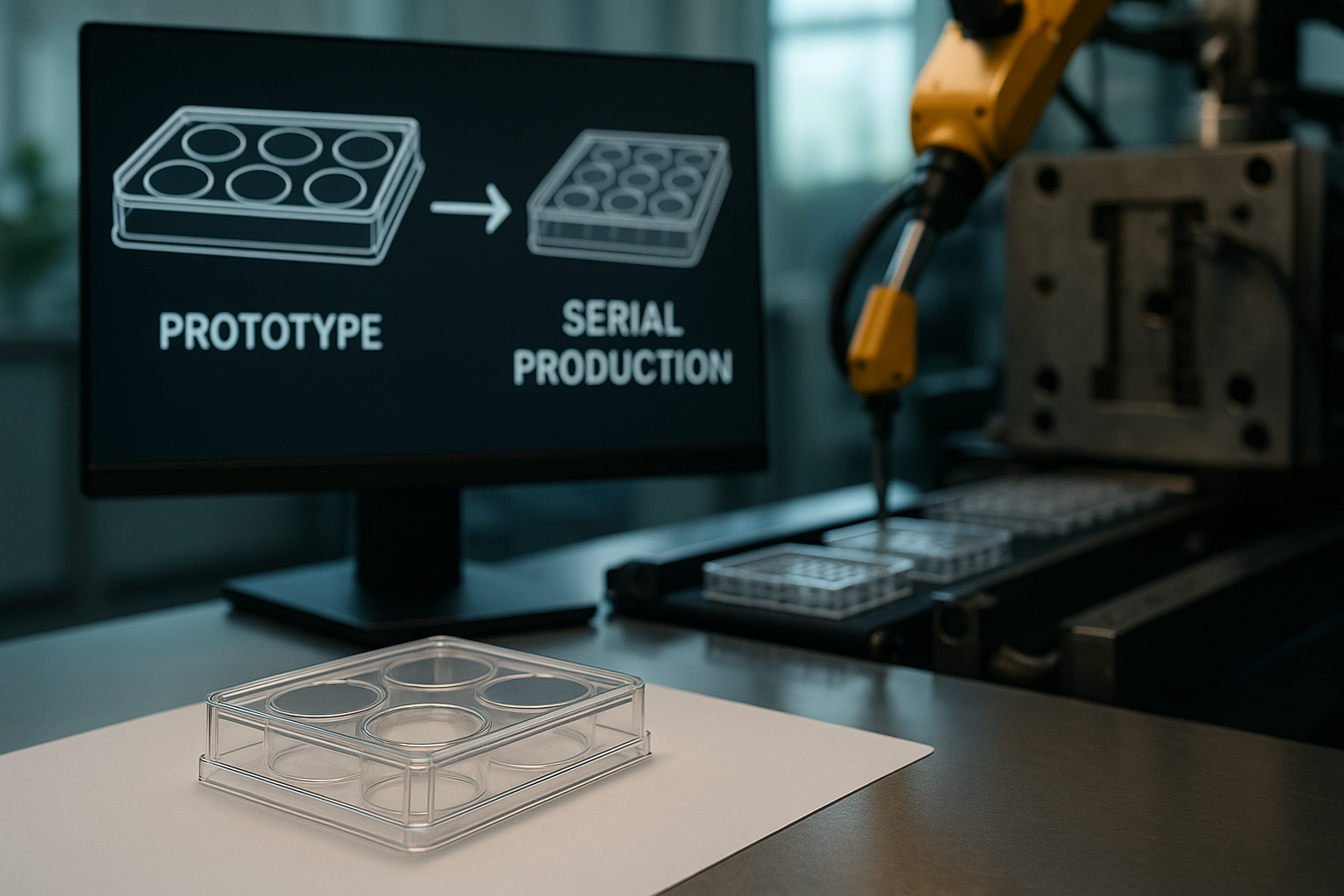
From Prototype to Serial Production (OEM)
Product Development in Lab Plastics
The Design for Manufacturing (DFM) Approach
Design-for-Manufacturing (DFM) is an essential methodology in developing laboratory plasticware, focusing on optimizing design features to ease production. This includes minimizing the complexity of multiwell plates and ensuring designs are suitable for mass production without sacrificing functionality. For instance, incorporating snap-fit features or limiting undercuts can simplify tool design, cutting down production time significantly.
- Reduce complexity to streamline the manufacturing process
- Incorporate functional features without compromising production ease
Material Selection in Laboratory Plastics
The choice of materials is crucial for product performance and compliance in lab settings. Common plastics like Polystyrene (PS), Polypropylene (PP), and Cyclic Olefin Copolymer (COC) offer varied benefits in transparency, chemical resistance, and temperature stability. Appropriate material selection ensures that products meet specific optical and biological requirements, critical for applications in cell culture and diagnostics.
- PS for optical clarity
- PP for high chemical resistance
- COC for excellent barrier properties
Tooling & Scale-Up
The Transition from Prototypes to Full-Scale Production
The scaling process from prototype to full industrial production involves several key phases: pilot tooling, pre-series production, and final tooling. Each phase requires rigorous testing and validation to ensure consistency, dimensional accuracy, and scalability. Reproducibility is paramount; hence, designs often undergo iterations based on pilot tool feedback before advancing to full-scale tooling.
- Iterative design improvements based on pilot trials
- Ensuring dimensional accuracy in pre-series runs
Ensuring Process Robustness
A robust manufacturing process is one that guarantees consistent product quality, irrespective of production scale. Process robustness is achieved through well-documented procedures, stringent controls on parameters such as temperature and pressure, and thorough testing for every production lot. This is especially crucial in industries like biotechnology, where product reliability directly impacts research outcomes.
- Implement comprehensive process controls and monitoring systems
- Conduct thorough testing at each scale-up phase
Injection Molding & Process Control
Core Manufacturing Technology: Injection Molding
Injection molding stands as the cornerstone of laboratory plasticware production, offering unmatched precision and consistency. This technique involves injecting molten plastic into a mold to create high-fidelity, complex shapes with tight tolerances. Process validation across various molding stages ensures uniformity and adherence to design specifications, essential for products like microplates used in high-throughput screening.
- Ensure precise control over molding parameters
- Maintain consistency across batches with rigorous process validation
Suitability for Regulated Environments
Laboratory plasticware manufacturing under regulated environments like cGMP and GMP ensures that products are consistently produced and controlled according to quality standards. This involves meticulous documentation, change control, and risk management processes. By adhering to these guidelines, manufacturers ensure that their products are suitable for sensitive diagnostic and pharmaceutical applications.
- Adopt comprehensive documentation practices
- Implement rigorous change control and risk management protocols
cGMP & GMP Manufacturing
Key Distinctions and Compliance
The difference between a development environment and a certified cGMP or GMP environment is substantial. While development environments focus on innovation and prototyping, cGMP and GMP compliance prioritizes the quality management system, traceable batch documentation, and structured validation procedures. These protocols are vital for ensuring product safety and efficacy, especially for life science applications.
- Continuous improvement through feedback loops
- Implementation of robust quality management systems
Qualification and Validation Principles
Qualification and validation processes are integral to confirming that manufacturing equipment and processes function within specified limits reliably. Operational Qualification (OQ) and Performance Qualification (PQ) phases assess whether products meet required quality specifications consistently, thereby fortifying trust in large-scale production capabilities.
- Perform OQ and PQ to validate equipment functionality
- Ensure documentation of all validation protocols
Continue reading to explore more advanced insights and strategies.
„`
„`html
Automation in Manufacturing
Streamlining Production with Advanced Robotics
The integration of automation and robotics in lab plasticware manufacturing significantly enhances efficiency and precision. The use of automated assembly lines reduces human error and increases throughput, particularly during high-demand cycles. In one case study, a biotechnology firm implemented automated robots in their production line, reducing lead time by 30% and ensuring tighter quality control.
- Invest in robotics to increase factory floor efficiency
Machine Learning for Predictive Maintenance
Machine learning algorithms have become instrumental in predicting potential equipment failures and scheduling timely maintenance, preventing costly production downtimes. By analyzing machine data and spotting early signs of wear and tear, manufacturers can transition from reactive to predictive maintenance strategies. This approach was notably effective in reducing unforeseen downtimes in a high-volume syringe manufacturing plant, improving equipment uptime by 25%.
- Leverage predictive analytics to minimize downtime
Sustainability in Manufacturing Processes
Eco-Friendly Practices in Lab Plastic Production
As environmental concerns rise, adopting sustainable manufacturing practices becomes imperative. Utilizing biodegradable materials and implementing recycling initiatives can reduce the carbon footprint of lab plastic production. A prominent example is a labware company that transitioned to using recycled polypropylene, cutting down plastic waste by over 200 tons annually. Additionally, energy-efficient equipment significantly reduces power consumption, contributing to a greener production footprint.
- Incorporate recycled materials to lower environmental impact
Energy Optimization Techniques
Optimizing energy usage is critical for reducing production costs and enhancing environmental sustainability. Implementing energy-efficient lighting, advanced HVAC systems, and smart grid technology helps manufacturers minimize energy consumption. For instance, a leading lab equipment producer reduced their energy bills by 35% through the installation of a solar panel system and switching to LED lighting.
- Optimize energy use with efficient infrastructure
Quality Assurance and Control
Advanced Testing Frameworks
Incorporating advanced testing frameworks is crucial in verifying the quality and safety of laboratory plasticware. This includes implementing automated testing systems that offer precise, real-time quality metrics. An advanced multiphase testing protocol was successfully adopted by a major diagnostic kit manufacturer, resulting in a 40% enhancement in defect detection accuracy.
- Utilize automated testing for consistent quality control
Statistical Process Control (SPC)
Statistical Process Control (SPC) involves using statistical methods to monitor and control production processes, helping to maintain consistent quality. By monitoring production data, manufacturers can identify variation trends and implement corrective actions swiftly. A case study of a vial manufacturing plant revealed that SPC implementation reduced process variance by 15%, leading to more consistent product quality.
- Adopt SPC techniques for improved quality assurance
Supply Chain Optimization
Leveraging Digital Supply Networks
The adoption of digital supply networks (DSNs) enables real-time data sharing, increasing transparency and efficiency in the supply chain. By harnessing IoT and blockchain technologies, manufacturers can track the entire lifecycle of materials and products with unprecedented accuracy. Implementing a DSN facilitated a major reduction in lead time for a global plasticware distributor, boosting customer satisfaction by 20% through faster delivery.
- Implement DSNs to enhance supply chain transparency
Risk Management in Procurement
Effective risk management during procurement is crucial in maintaining stability amidst global supply chain disruptions. Building strategic supplier partnerships and diversifying sourcing strategies ensure reliable supply chain continuity. A laboratory consumable producer mitigated risk by establishing a multi-supplier model, which reduced supply chain disruptions by 40% during geopolitical tensions.
- Diversify suppliers to manage procurement risks effectively
Regulatory Compliance and Documentation
Meeting ISO Standards for Laboratory Plastics
Adhering to ISO standards is critical for ensuring that lab plasticware meets global quality and safety benchmarks. Regular audits and updates to compliance protocols maintain trust and reliability in lifetime performance. For instance, a company producing pipette tips achieved ISO certification, leading to expanded market access and increased customer confidence by 50%.
- Ensure continuous compliance with ISO standards
Effective Change Management Practices
Implementing robust change management systems is key in maintaining regulatory compliance and product quality. This involves structured documentation of process changes and thorough impact assessments. A significant development was made by a chemical reagent supplier that strengthened their change control system, which resulted in improved regulatory alignment and reduced non-compliance issues by 30%.
- Implement rigorous change management protocols to adapt efficiently
The Role of Innovation in Competitive Advantage
Pioneering New Product Development
Innovation is the lifeblood for achieving a competitive edge in laboratory plastic manufacturing. By investing in R&D and adopting cutting-edge technology, manufacturers can develop unique, high-performing products that meet new market demands. For example, a biotech firm developed an innovative pipette material that demonstrated enhanced chemical resistance, capturing a new market segment.
- Drive competitive advantage through continuous innovation
Leveraging Collaborations and Partnerships
Strategic collaborations and partnerships expand technical expertise and market reach. Engaging in joint ventures with research institutions can lead to breakthrough innovations and product developments. A successful partnership between a labware producer and a top university resulted in the development of novel diagnostic testing consumables, leading to a significant market share expansion.
- Foster collaborations for mutual growth and innovation
Next, we’ll wrap up with key takeaways, metrics, and a powerful conclusion.
„`
„`html
Future Trends in Laboratory Plasticware Manufacturing
Integrating AI for Smarter Production
The future of lab plasticware manufacturing is set to be transformed by the integration of artificial intelligence (AI). With AI, manufacturers can achieve higher levels of process automation, enabling more intelligent scheduling, real-time quality monitoring, and superior resource management. The implementation of AI-driven systems in a lab container production facility led to a 50% reduction in waste and a marked improvement in production cycle time by 35%.
- Embrace AI technologies for smarter and leaner manufacturing processes
3D Printing for Customized Labware
3D printing is revolutionizing the approach to manufacturing, allowing for the creation of highly customized and complex labware while reducing material usage. This technology enables rapid prototyping and production, allowing labs to tailor equipment specifications to meet bespoke research needs. A recent innovation by a medical research firm utilized 3D printing to produce tailored microfluidic devices, achieving a production cost reduction of 40%.
- Utilize 3D printing for bespoke and efficient labware production
Customer-Centric Manufacturing Approaches
User Experience in Product Development
Involving end-users in the product development process ensures that the laboratory plasticware meets the practical needs of scientists and technicians. By integrating user feedback into design and functionality, manufacturers can enhance usability and satisfaction. A focus group methodology adopted by a centrifuge tube manufacturer revealed design flaws which, when addressed, led to an increase in user satisfaction by 60%.
- Incorporate user insights in developing user-friendly plasticware
Personalized Customer Interactions
The shift towards personalized customer interactions is redefining service in the manufacturing sector. By using CRM (Customer Relationship Management) systems and personalization techniques, manufacturers can better understand customer needs and deliver tailored solutions, enhancing loyalty and retention. A laboratory supply company increased its repeat customer rate by 45% through personalized interactions and dedicated support services.
- Enhance customer relationships through personalization and dedicated support
Conclusion
Throughout this exploration of laboratory plasticware manufacturing, we have delved into the critical developments that drive efficiency, sustain environmental responsibility, ensure quality, and ultimately lead to competitive advantage. Automation and robotics streamline production lines, allowing for heightened precision and increased output, while machine learning enriches maintenance protocols, guarding against unnecessary downtimes.
Sustainability in manufacturing is not merely an ethical obligation but a competitive imperative. By adopting eco-friendly practices and optimizing energy consumption, companies can significantly reduce their environmental impact. Quality assurance has been bolstered with advanced testing and SPC methodologies, ensuring that each product adheres to strict standards, thus maintaining customer trust.
Supply chain management has taken a digital leap with the advent of technology-driven networks, offering enhanced transparency and efficiency. Meanwhile, regulatory compliance remains a cornerstone of manufacturing operations, safeguarding product integrity through rigorous adherence to ISO standards and robust change management systems. Innovation remains the linchpin of industry leadership, fueled by bold product development initiatives and strategic collaborations.
As we look forward, the infusion of AI and 3D printing stands to transform manufacturing landscapes profoundly, fostering smarter production cycles and customized solutions. Emphasizing customer-centric practices, from user experience-driven design to personalized service, promises to deepen market engagement and customer loyalty.
A holistic embrace of these strategies not only advances the industry’s capabilities but also aligns it with future potential and societal needs. For manufacturers poised at the cutting edge, these innovations present a roadmap to not merely survive but thrive in a competitive and ever-evolving market. To echo the thrust of our exploration, the journey towards excellence in laboratory plasticware manufacturing is as much a commitment to the present as it is to reimagining the future. The seeds we plant today in innovation, sustainability, and quality assurance will define not only the products we deliver but the impacts we impart upon the world.
In this era of unprecedented advancement, let us commit to leveraging these insights to transform challenges into opportunities and sketching pathways towards a more sustainable, efficient, and innovative future.
„`
 German
  English
Leave a Reply