
„`html
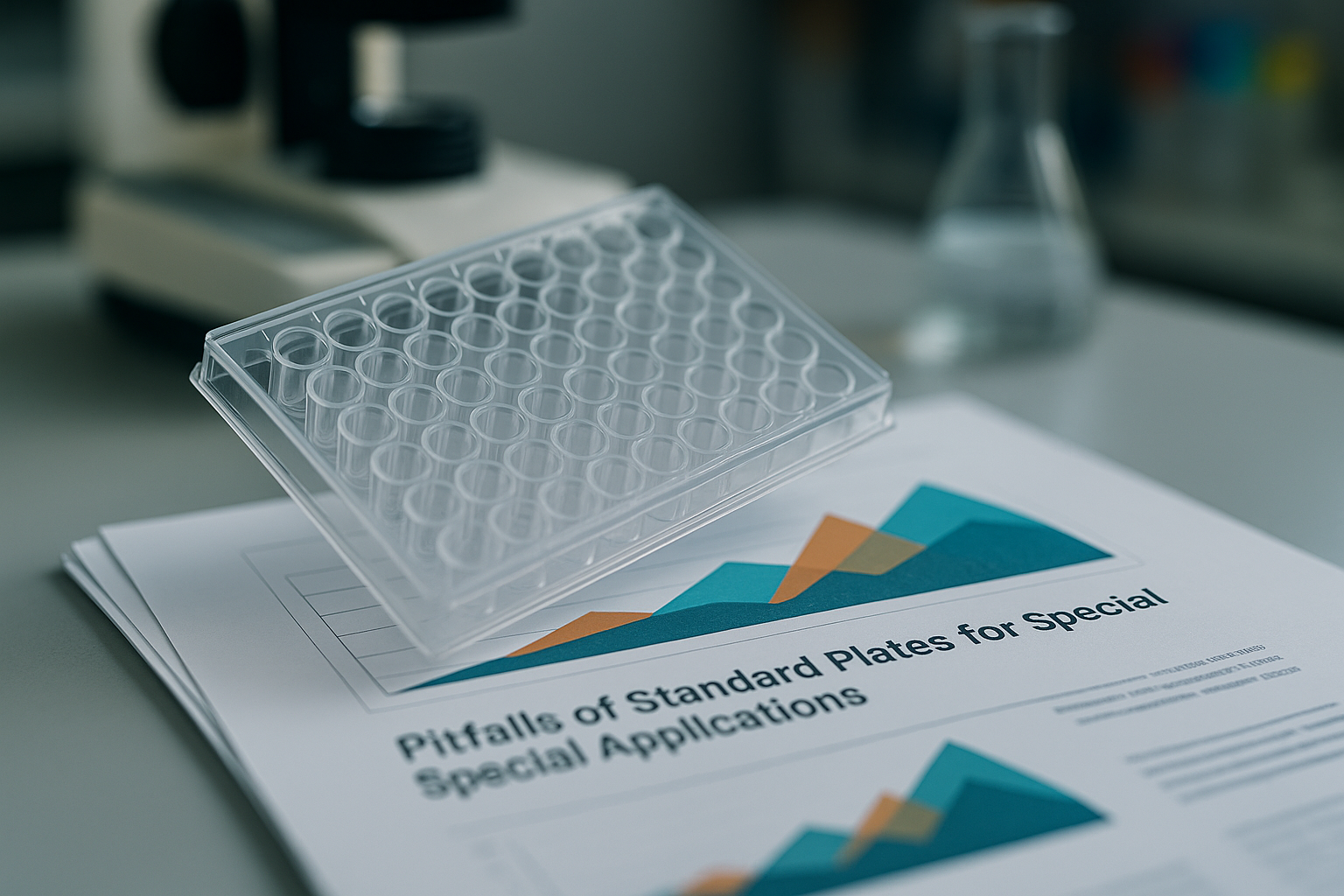
Pitfalls of Standard Plates for Special Applications
In the ever-evolving landscape of life sciences, where innovation is key, researchers frequently encounter challenges with conventional laboratory tools, particularly regarding standard plates in specialized applications. These plates, while sufficient for traditional tasks, often fall short in more nuanced and demanding research processes. This article explores the limitations of standard plates within advanced laboratory settings, focusing on critical aspects such as material, design, and process control. Drawing from real-world scenarios, we will delve into the development and optimization of laboratory plastics, highlighting technological advances and the benefits of adaptable solutions.
Common Challenges and Limitations of Traditional Approaches
Inflexibility in Design and Material
Standard plates are typically designed for broad application ranges, prioritizing cost-effectiveness and production efficiency. However, this often results in inflexibility, limiting their use in specialized applications like high-throughput screening (HTS) or complex cell culture experiments. For instance, traditional multiwell plates might lack the precise optical clarity required for advanced imaging or the chemical resistance needed for specific assays.
- Lack of custom surface treatments, affecting cell adhesion and growth.
- Incompatible with high-resolution imaging due to suboptimal material clarity.
- Poor chemical resistance, leading to contamination risks.
Technological Advances and Automation Trends
The Rise of Customization in Labware
To address the limitations of standard plates, the industry is witnessing a shift towards customized solutions. Advances in injection molding and material science allow for tailored designs that meet specific research demands. This customization extends to surface treatments, such as tissue culture treatments or special coatings that enhance cell viability and experimental outcomes. Automation in production processes further ensures consistent quality and scalability, crucial for both R&D and industrial-scale applications.
- Adaptive design-for-manufacturing (DFM) processes.
- Innovative materials like PS, PP, and COC for diverse applications.
Practical Examples and Workflows Using Live-Cell Imaging
Enhancing Research with Advanced Imaging Systems
Live-cell imaging has become an indispensable tool in modern biological research, enabling real-time observation of cellular processes. The zenCELL owl exemplifies a compact, incubator-compatible live-cell imaging system that integrates seamlessly with customized laboratory plates. This system allows for continuous monitoring and automation, significantly enhancing data reproducibility and experimental workflow efficiency.
- Real-time, non-invasive monitoring of cell cultures.
- Improved data accuracy through automated imaging.
- Compatibility with multiwell formats for diverse applications.
Continue reading to explore more advanced insights and strategies.
„`
„`html
Leveraging Specialized Plates for Cellular Microenvironment Control
Tailoring the Microenvironment for Enhanced Experimental Validity
The precision required in modern biological research, especially in studies involving cellular microenvironments, calls for more than standard plates can offer. Specialized plates have emerged as essential tools equipped with advanced surface coatings and customizable configurations that allow researchers to recreate physiological conditions with greater accuracy. For example, microfluidic channels integrated into plate designs mimic the flow dynamics present in blood vessels, bringing us closer to replicating in vivo conditions in vitro.
- Employ specialized plates to simulate accurate physiological conditions.
Integrating Digital Tools for Enhanced Experimental Outcomes
Smart Plates and the Data-Driven Laboratory
With the advent of smart technologies, laboratories can now integrate digital tools directly into their workflow. Smart plates equipped with embedded sensors offer real-time data collection and condition monitoring. This integration aids in better understanding of the cell growth conditions and enables rapid adjustments to optimize results. A notable breakthrough is the use of microelectromechanical systems (MEMS) technology, which provides precise environmental control and feedback without manual intervention.
- Incorporate smart plates for real-time data acquisition and process optimization.
Utilizing High-Throughput Formats for Screening Applications
Maximizing Efficiency in Drug Development
High-throughput screening (HTS) is an integral part of drug discovery, where thousands of compounds can be screened efficiently using multiwell plates designed to withstand demanding conditions. Recent developments have seen the integration of microarray technology with these plates, allowing simultaneous multiple assay measurements and thereby reducing both time and cost associated with extensive screenings. Such innovations streamline early-stage drug testing and have proven instrumental in rapid response scenarios, such as during pandemic drug research.
- Optimize drug discovery efficiency using high-throughput multiwell designs.
Customizable Solutions for Specialized Research Needs
Adaptive Manufacturing for Unique Experimental Tools
As research questions grow more complex, so too does the demand for labware that can meet highly specific requirements. 3D printing technologies allow researchers to design and produce bespoke plates tailored to their exact experimental needs—from unique geometries to custom well sizes. This flexibility reduces the gap between concept and experimentation, enabling rapid prototyping and innovation within the lab.
- Leverage 3D printing to develop customizable labware solutions swiftly.
Enhancing Reproducibility with Automation Alignment
Standardizing Processes for Greater Consistency
The reproducibility crisis in scientific research often stems from variabilities in manual handling and environmental conditions. Automated systems, when aligned with specialized plates, offer precise control and consistency, mitigating these issues. Automated pipetting and robotic systems ensure uniform sample handling, while advanced environmental control chambers maintain optimal conditions across experiments, both integral for reproducible, high-quality data.
- Implement automation to ensure consistent experimental conditions.
Navigating Regulatory and Compliance Considerations
Ensuring Safety and Compliance in Specialized Applications
In any specialized research, compliance with regulatory standards is critical. Specialized plates should be designed with compliance in mind; materials used should meet rigorous standards (such as ISO 13485 for medical devices). Understanding the regulatory landscape ensures that labs remain compliant, avoiding costly setbacks and ensuring that research outcomes are recognized globally.
- Choose plates that meet necessary compliance and regulatory standards.
Exploring the Role of Collaborative Innovation
Partnering for Breakthroughs in Laboratory Technology
Collaboration between research institutions, industry players, and manufacturers is pivotal for driving innovations in laboratory tools. Such partnerships can lead to co-development of cutting-edge solutions uniquely suited for specific scientific inquiries. Collaboration often leads to shared insights and accelerates the development of highly specialized equipment that pushes the boundaries of possible research outcomes.
- Engage in partnerships to co-develop advanced laboratory solutions.
Next, we’ll wrap up with key takeaways, metrics, and a powerful conclusion.
„`
„`html
Adapting to Technological Advancements
Future-Proofing Laboratories
As technology continues to advance at a rapid pace, it is crucial for laboratories to adapt and integrate new tools that promote efficiency and effectiveness in research. Emerging technologies like artificial intelligence and machine learning are beginning to play a significant role in data analysis and predictive modeling, leading to more informed decision-making processes. Researchers should remain open to embracing these technologies and invest in labware and systems that support the integration of such cutting-edge innovations.
- Proactively integrate latest technologies to enhance research capabilities.
Sustainability Considerations in Labware Design
Balancing Innovation with Environmental Responsibility
As the scientific community strives for greater innovation, it must also reckon with the environmental impacts of laboratory operations. Sustainable labware design is imperative, focusing on the use of eco-friendly materials and reduced-resource processes. This approach helps in minimizing the ecological footprint while maintaining high performance standards. By fostering sustainability, labs not only comply with environmental regulations but also contribute to the broader goal of global environmental stewardship.
- Adopt sustainable practices in labware production and usage.
Looking to the Future: Resiliency in Research
Preparing Laboratories for Uncertainty
The ever-evolving landscape of scientific research calls for a mindset that is resilient and adaptable in the face of uncertainty. This requires a shift from siloed workflows to more dynamic and flexible systems capable of responding to unforeseen challenges, such as sudden surges in demand during public health crises. By emphasizing resilience in both design and operational strategies, laboratories can better anticipate and respond to future scientific challenges, ensuring their efforts remain impactful and relevant.
- Build resilient systems to withstand and adapt to future challenges.
Conclusion
The exploration of specialized plates and innovative laboratory tools has underscored the transformative potential these advancements hold for scientific research. As discussed, the ability to recreate physiological conditions more accurately, harness data from smart systems, and streamline processes through high-throughput designs is pivotal for elevating the quality and efficiency of experimental outcomes. Not only do these innovations propel forward drug discovery and cellular research, but they also ensure a more robust and reproducible scientific inquiry.
Moreover, the integration of new technologies and customizable solutions driven by 3D printing has paved the way for unprecedented flexibility and creativity. By addressing regulatory considerations, research institutions can safeguard against compliance issues, reducing the risk of setbacks that could impede scientific progress. Furthermore, collaboration remains a cornerstone of technological advancement, enabling the pooling of resources and ideas to develop solutions that push the boundaries of what is possible.
In conclusion, the shift towards embracing advanced laboratory tools serves as a testament to the commitment of the scientific community in pushing the frontiers of knowledge and innovation. Labs that prioritize adaptive manufacturing, automation, and sustainable practices not only thrive in today’s demanding research landscape but also lay a solid foundation for future scientific endeavors. The journey toward specialized, efficient, and sustainable lab practices continues to evolve, and it is imperative for researchers and industry leaders to align their efforts with these innovative trends.
To all stakeholders in the scientific arena, now is the time to invest in these transformative technologies, fostering an environment that is conducive to groundbreaking discovery. By doing so, we not only enhance the reliability and impact of current research efforts but also inspire the next generation of scientific breakthroughs that hold the potential to benefit society on a global scale.
Take action today and become a part of this pioneering journey toward excellence in research—because the future of science awaits no less than our most innovative self.
„`
 German
  English
Leave a Reply