
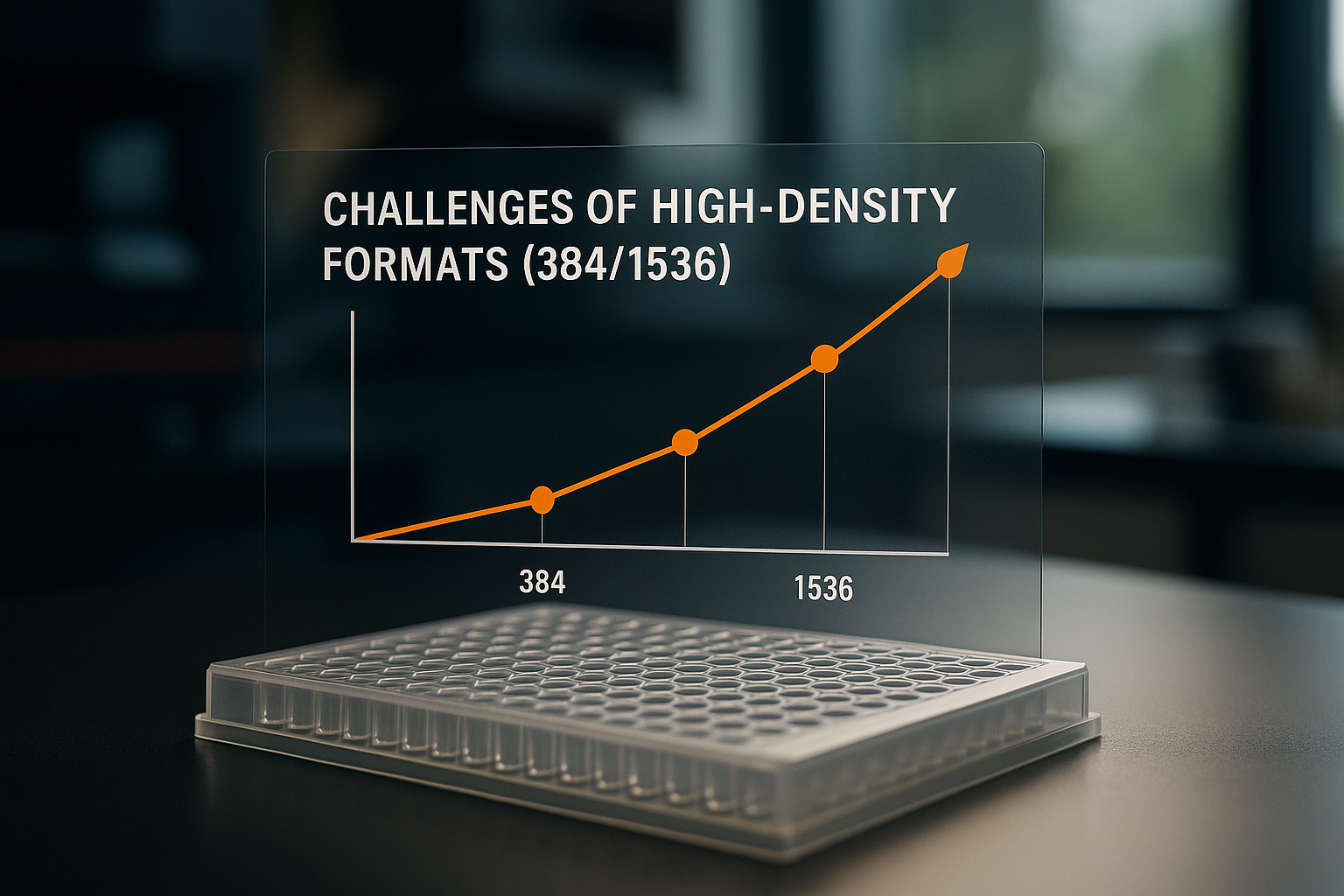
Challenges of High-Density Formats (384/1536)
The increasing demand for high-throughput screening and analysis in modern laboratories has significantly influenced the development of high-density plate formats such as 384-well and 1536-well plates. These formats are essential for researchers aiming to maximize data output while conserving space and materials. However, navigating the complexities of these high-density formats presents a series of challenges unique to their design, manufacturing, and application. This article delves into the obstacles faced in creating these advanced labware solutions and provides insight into overcoming these hurdles.
Design and Development Challenges
Multiwell Plate Engineering
Designing 384-well and 1536-well plates requires a meticulous approach to engineering due to the increased number of wells within a limited surface area. The design-for-manufacturing (DFM) process is crucial in ensuring that each well is properly shaped and positioned to maintain uniformity across the entire plate, which is critical for accuracy and reproducibility in experiments.
- Precision in well geometry and uniformity
- Ensuring structural integrity while minimizing cross-sample contamination
- Optimization for automated handling systems
Material Selection
Selecting appropriate materials is a pivotal step in producing high-density plates. Materials such as polystyrene (PS), polypropylene (PP), and cyclic olefin copolymer (COC) are typically considered based on their optical clarity, chemical resistance, and compatibility with surface treatments. For applications needing superior optical properties, like fluorescence assays, COC may be the material of choice, given its low autofluorescence and high chemical resistance.
- Consideration of optical and chemical properties
- Impact of material properties on surface coatings
Surface Treatments
High-density formats often require specific surface treatments to enhance cell culture compatibility or assay performance. These treatments can range from standard tissue culture (TC)-treatments to advanced coatings that support specific cellular interactions or reduce nonspecific binding. Properly treated surfaces are essential for supporting consistent cell growth and data accuracy.
- Balancing cell adherence and growth with treatment constraints
- Adapting treatments to different biological assay needs
Continue reading to explore more advanced insights and strategies.
„`html
Precision in Liquid Handling and Dispensing
Automation and Calibration
In high-density formats like 384-well and 1536-well plates, precision in liquid handling and dispensing is paramount. Automated liquid handling systems must be meticulously calibrated to manage the minute volumes typical in these formats, with dispensation errors leading to significant data skewing. Automated systems must possess the capability to aspirate and dispense nanoliter to microliter volumes consistently, without cross-contamination.
- Regular calibration and maintenance are essential in preventing volume variations.
- Employing precision robotics and sensors can enhance reliability and accuracy.
Assay Development and Miniaturization
Optimizing Protocols for Small Volumes
High-density formats require miniaturization of assay protocols, ensuring that reactions occur accurately within smaller volumes. This includes adjusting reagent concentrations and adapting buffer systems to maintain equivalent assay performance and sensitivity. Companies have invested in developing specific reagent kits optimized for high-density plates, further aiding researchers in their pursuit of accurate data.
- Utilizing pre-optimized reagent kits can streamline protocol adjustments.
- Implement replicate assays to verify data consistency across smaller volumes.
Data Management and Analysis
Handling Large Datasets Efficiently
The vast number of data points generated by high-density formats necessitates robust informatics solutions to handle, analyze, and interpret results. Advanced data management software must be integrated into laboratory workflows to facilitate real-time analysis, data validation, and storage. Cloud-based platforms offer scalable solutions for collaborating and managing large datasets securely.
- Integrate laboratory information management systems (LIMS) for streamlined data processing.
- Implement data analytics tools that accommodate high-throughput environments.
Advanced Imaging Techniques
Implementing High-Resolution Detection Systems
To fully leverage the potential of high-density formats, detection systems need to provide high-resolution and high-sensitivity imaging. Techniques such as fluorescence microscopy, high-content screening, and time-resolved fluorescence are essential for reading data from these plates without compromising resolution. Investment in modern imaging systems with automation capabilities can significantly enhance throughput.
- Consider using integrated systems that allow real-time imaging and analysis.
- Select imaging equipment with customizable parameters for diverse assay needs.
Managing Evaporation Challenges
Innovative Solutions for Reducing Sample Loss
Evaporation is a significant challenge when working with the small volumes typical in high-density plates. This can lead to altered concentrations and invalid results. Approaches such as using humidity-controlled incubators, applying seals and lids during incubation, or employing reagent additives to stabilize volumes are crucial in maintaining sample integrity.
- Regularly monitor incubation conditions to prevent adverse evaporation effects.
- Use evaporation-reducing plate seals during high-temperature or long-term assays.
Standardization and Compliance
Ensuring Consistency Across Platforms
The use of standardized plate formats and accurately calibrated equipment is critical in ensuring cross-laboratory consistency. Compliance with industry standards such as SBS/ANSI for plate formats aids in maintaining uniform practices. Regular training and auditing within labs further ensure that high-density formats are utilized effectively and comply with necessary regulations.
- Adopt internationally recognized standards to ensure cross-comparability.
- Implement regular standard operating procedure (SOP) reviews to stay aligned with best practices.
Case Study: Biotech Company Optimizes Assay Throughput
Driving Innovation with High-Density Plate Adoption
A leading biotechnology firm successfully integrated 1536-well plates into their high-throughput screening pipeline to expedite the drug discovery process. By incorporating automation solutions and novel assay development, they were able to cut costs by 25% and increase screening throughput by 40% over a 12-month period. Their approach focused on thorough staff training and incremental adoption, mitigating initial challenges associated with the transition.
- Implement change management strategies to support workforce adaptation.
- Combine phased implementation with comprehensive training sessions.
Next, we'll wrap up with key takeaways, metrics, and a powerful conclusion.
„`
„`html
Enhanced Throughput Strategies
Leveraging Advanced Liquid Handling
High-density formats offer immense potential for enhanced throughput in scientific research, but realizing these benefits requires sophisticated liquid handling strategies. Advanced systems with multi-channel pipetting capabilities can significantly reduce processing times. The incorporation of intuitive software for scheduling and error-checking further ensures smooth workflow integration. By prioritizing flexibility in liquid handling automation, laboratories can swiftly adapt to varied experiment setups without compromising quality or efficiency.
- Utilize multi-channel pipets for parallel processing of multiple samples.
- Select systems with user-friendly interfaces and integrated error detection.
Quality Control and Assurance
Maintaining Consistency and Reliability
As high-density formats become integral to various applications, maintaining stringent quality control (QC) protocols is essential to ensure reproducibility. Systematic validation of equipment, thorough verification of reagents, and regular QC checks contribute to consistency across experiments. The integration of real-time monitoring systems provides immediate feedback, enabling researchers to rectify discrepancies promptly and uphold assay integrity.
- Conduct routine verification of equipment performance and calibration.
- Implement continuous QC checks with comprehensive documentation.
Future Prospects in High-Density Screening
Innovations and Opportunities
The future of high-density screening holds exciting prospects with advancements in AI-driven analysis and machine learning (ML) integration. These technologies promise to redefine data interpretation, paving the way for more nuanced insights and predictions. Furthermore, the evolution of 4D imaging techniques will expand the understanding of dynamic processes in biological systems, enhancing the utility of high-density formats in cutting-edge research.
- Explore AI and ML applications for enriched data analysis and forecasting.
- Keep abreast with advancements in imaging technology for improved assay outcomes.
Conclusion
The transition to high-density formats, such as 384-well and 1536-well plates, can radically transform laboratory productivity and data quality. Precision in liquid handling and assay development, coupled with robust data management systems, forms the cornerstone of successful integration. The ability to manage evaporation, enforce standardization, and leverage advanced imaging techniques ensures the accuracy and reliability of experimental results. Strategies that incorporate automation, rigorous QC protocols, and innovative liquid handling systems further expedite throughput and elevate research efficiency.
The comprehensive application of these methodologies has been illustrated in practical settings, notably in advanced biotechnological contexts where transformative outcomes have been achieved through the strategic adoption of high-density screening. As laboratories worldwide continue to embrace these formats, they unlock unprecedented potential in various domains, from pharmaceuticals to environmental science.
Embarking on this path requires more than just technological upgrades; it demands a cultural shift towards innovation and resilience. As we move into an era where data is as valuable as the research itself, laboratories are urged to harness the power of high-density formats to propel discovery and innovation. By fostering an environment of learning and adaptability, researchers can transform challenges into opportunities, persistently pushing the frontiers of science.
High-density formats have the potential to redefine science’s pace and scope. Researchers are encouraged to innovate relentlessly, question continuously, and embrace these technological advancements. As you ponder implementing these strategies, remember: each step towards optimization and modernization is a leap towards groundbreaking discoveries. Now is the moment to lead the charge in revolutionizing scientific processes, ensuring your laboratory stands at the forefront of the future’s most pivotal innovations.
„`
 German
  English
Leave a Reply